Friday, 6 December 2013

Spitalfields, Yesterday and Today

Hawksmoor's Christ Church, Spitalfields
London is a second home to me, engraved in consciousness as much as New York and Paris are.  I’ve been moving between the three points of that triangle a good part of my adult life.  So here I am again, a projected stay of nearly four months, and happy with the prospect. At present I’m staying with my friend the poet Mimi Khalvati, which makes being here especially homelike. She has a pretty dwelling in Stoke Newington, Hackney, the rooms filled with mementos from Iran, which she left at age six when she came to England.  Her first professional career was as an actor in theatre, but in mid-life she charted a different course and eventually became one of Britain’s leading poets.  We first met in 2005 and is now one of my closest friends here.

I had errands to do around Liverpool Street Station yesterday and once they were done decided to walk over to Spitalfields, quite close by. I first got to know the district in 1986, when I was staying in London on a Guggenheim fellowship. What led me to seek it out was the Peter Ackroyd novel Hawksmoor!, a fictional treatment of the life of the 18th-century neoclassical architect Nicholas Hawksmoor. Christ Church, Spitalfields, one of his best designs, is a dominant neighborhood landmark, along with the old Spitalfields Market. Spitalfields also made a quantum leap in notoriety when Jack the Ripper (with the help of a knife) claimed it as his turf during the shadowy era of “the other Victorians.”   

Back in 1986, a mutual friend effected an introduction to an American named Dennis Severs, who had lived in London for nearly two decades, one of the pioneers celebrated for reclaiming the Spitalfields environ from the dereliction it had fallen into.  Dennis loved London as few people have ever done and had a fantastically detailed knowledge of the city, since he had begun working as a tour guide shortly after he first arrived.  Eventually, he bought a house at 18 Folgate Street and filled it with old furniture and décor gathered from hither and yon. A year or so before I met him, he’d developed a sort of theatrical presentation, using the four floors of the house as his set. He invented a narrative about an émigré Huguenot family come to London after Louis XIV’s Edict of Nantes expelled all Protestants from France. The Huguenots who settled in Spitalfields were silk weavers and, in time, became prosperous Londoners. Dennis’s narrative took the family through several generations, each floor embodying the evolution in their fortunes, while incidentally summarizing concurrent changes in British society and politics. Recorded texts, changes in lighting and even a few kinetic effects helped move the narrative along.  (I didn’t forbear back then to mention to Dennis that there were a few mistakes in his recounting of history, but he shrugged that off and reminded me that theatre is fiction.) Somewhat incongruously, the top floor was a sort of résumé of Dickens A Christmas Carol. But that popular codicil assured the success of Dennis’s nightly show, and certainly it was in accord with the atmosphere of old Spitalfields.  Less than ten years after I met him, Dennis died of causes related to HIV infection.  I assumed that his house would be dismantled and sold, but, during my walk around Spitalfields, I came to 18 Folgate, and saw twin Christmas trees outside the door and a notice in the window, giving times when the house could be visited. So in one form or another, his work remains with us. I’ll try to come back and see what is currently being shown there. The old door-knocker in the shape of a sphinx's head still exerts a pull. Let me also mention that Dennis appears in a long poem of mine titled “Eleven Londons,” which was recently published in The Battersea Review.  Here’s the online link if anyone is curious.

http://thebatterseareview.com/poems/146-alfred-corn

There are also a couple of Spitalfields scenes in my 1997 novel Part of His Story, which is also set in London and has a past/present structure that might remind some readers of Dennis’s theatrical piece. To state the obvious, writers draw on hundreds of sources when composing any new work.

Continuing the Spitalfields stroll, I peeped in at Verde & Company, a tea-shop on the ground floor at the corner of Brushfield and Gun Streets.   The building is one of the “period” structures that still remain, and at some point it was bought by Jeanette Winterson, who founded the shop.  It has a green awning from which depend a dozen baskets in different shapes.  Small tables inside accommodate a few clients who can enjoy an hour of conversation over tea and pastry. The effect of quaintness is strong--a quality that used to be common in London but has now become pretty scarce.  Needless to say, Spitalfields has been invaded by large modern structures in steel and glass.  The old iron market is surrounded by designer boutiques, but at least the central part, open to the air, is the site of a daily Marché aux Puces, London-style, with all sorts of tat, vintage finery, collectibles, and crockery on offer.

Close by, the imposing edifice of Christ Church, which hasn’t changed. In Spitalfields you find the Ghosts of Christmas Past and Present. Looking at all the recent Modernist architecture and smart shops that have sprung up, you also see the Future. Up to you to choose which you prefer.  For me the Present will do, even if it isn’t yet a Christmas Present.            

Sunday, 1 December 2013

Death of a Naturalist

Like so many others, I was saddened to hear of Heaney’s death this past summer. I knew that Heaney had recovered from a serious stroke a couple of years earlier, and indeed he looked thinner and rather more fragile than the young man I first met back in, I believe, early spring of 1978. The occasion was a reading he gave at Yale. He wasn’t well known in the States then. Probably less than forty people made up the audience. Heaney read several sonnets from the “Glanmore” sequence, one of his loveliest. Then, in view of the fact that no one had arranged a post-reading reception, it seemed natural and cordial for the Resident Fellow to invite him and some of the audience to have a drink at Silliman College. I recall shaking the hand of this vigorous, hesitant man with prematurely gray hair nearly down to his shoulders, wearing jeans and a plaid cotton shirt. He had trouble meeting my eyes, and I don’t think he was fully comfortable in those surroundings—but then who could blame him at that stage of the game?
     The next meeting came perhaps five or six years later, when I was living in New York. He had given a reading at the 92nd Street YMHA, at the invitation of Grace Schulman, who was the director of the Poetry Center. Grace had people to her place down in Greenwich Village after the event. By now Heaney was a famous poet, confident, relaxed, wearing a suit, and surrounded by admirers. With him was his wife Marie, who I think was glad to have someone to talk to while fans monopolized her husband. I found Marie unaffectedly down to earth, patriotic about her origins in the North of Ireland, with a sharp eye and wit, not to mention being lovely to look at. I forget the stimulus for it, but at some point Heaney was led to recite one of Wyatt’s best known poems, “Whoso list to hunt, I know where is an hind.” It was in that era that the current revival of interest in Wyatt began—and may that revival endure. I knew by then that it was a near certainty Heaney would one day be tapped for the Nobel. There was no mistaking his ability and the aptness of awarding the prize to a poet from Northern Ireland. And perhaps it was just such a certainty that convinced me to make no attempt to stay in touch in the years after. Besides, sincere admiration isn’t by itself a basis for a long-lasting association. I could always meet him on the page, and that was the main thing. News of his personal life came to me from people we knew in common, and (strange thing among poets) I never heard any reports of nastiness or arrogance where Heaney was concerned. He was admired as poet and as human being. 
     In my book Atlas: Selected Essays, 1989-2007, his work is discussed at some length.  After the piece was commissioned and published, he went on to publish several more books, so needless to say my essay doesn’t cover his career; but I think it remains a useful starting point.  There is always much to say about Heaney's poems. A sequence titled “Clearances” (from The Haw Lantern) gives a moving portrayal of his mother and recounts her death; and “Squarings,” from the next book, which does much the same for his father. Of course an elegy eulogizes the deceased, but it is also a dry run for the elegist’s own eventual departing this life. Both sequences have that aspect. In The Human Chain, his most recent book, Heaney moved a step closer to confrontation with mortality in a brief sequence titled “Chanson d’Aventure”, which describes being driven in an ambulance to a distant hospital.  Directly after this, the book’s title poem describes the manual labor of heaving sacks of meal onto a trailer, an action Heaney turns into a metaphor for the final unloading of our mortal coil. He realizes he would no longer have the strength to do such heavy work, labor characterized in the poem as, “A letting go which will not come again./Or it will, once. And for all.” 
     To state the obvious, Heaney was preparing himself. And it may be that in advance of this final admission to hospital, he already knew what his last words were going to be. Isolated from Marie in an emergency bay, he text-messaged to her the Latin phrase “Noli timere”, that is, “Fear not”.  He was sending a variant on Jesus’ words to Mary Magdalene, spoken in the garden on the Sunday of the Resurrection: “Noli me tangere”. This is usually translated as, “Do not touch me”, but a rather more accurate translation would be, “Do not hold on to me”. What’s being recommended in the gospel account is a letting go. Heaney would agree with the instruction, I think, (the phrase is included in the Wyatt sonnet mentioned above), and he added his own reassurance that there is no need to be fearful. The death of a naturalist is indeed natural, part of the human cycle and also part of the “human chain.”  The “natural man” has been put off and is now replaced by his writings, which continue to excite, instruct, and reassure his readers.  The letting go has now taken place. It is once, and it is “for all”. All of us.   

Attending the funeral, Bono and Alison Hewison
   

Friday, 27 April 2012

London, Trieste, Duino

Arch of Riccardo, Trieste
Duino Castle, seen from the east
Entrance to Duino Castle


The second week of April, I left Cambridge and made a journey down to Trieste, in the extreme northeastern corner of Italy. It’s in the region known as Friuli-Venezia Giulia, just south of Slovenia and northwest of Croatia.  Trieste was part of the Austro-Hungarian Empire until the end of the First World War, a history that makes it noticeably different from other Italian cities, but also one that establishes a link with several large Hapsburg capitals elsewhere. There is a family resemblance between Vienna, Prague, Budapest and Trieste, seen primarily in the large scale of the public buildings, especially those flanking Piazza dell’Unitá, the main square. In more residential areas, houses and large common dwellings are often stuccoed and painted light colors—ochre, terracotta, tan, and what I call Maria Theresa yellow, the color used for Schönbrunn Palace in Vienna and many other parts of Maria Theresa’s empire.
          My hotel was in the old medieval quarter not far from Piazza Unitá, a place of narrow twisting streets that gradually climb up to the Cattedrale di San Giusto, which overlooks Trieste.  This neighborhood was until recently a slum but has been renovated, at least partly. My first walk took me up toward the Cathedral, past a Roman arch known as the “Arco di Riccardo,” to which a later building was attached as if by super-glue. (The Roman name for the ancient city was Tergestum.)  Farther on, I reached the excavated Roman theatre, which sits there unperturbed a few yards from one of the city’s modern thoroughfares. You’d have no trouble imagining plays by Terence or Plautus being staged there. More like reverie than experience (and still more in retrospect) to stand there in the sprinkling rain and gaze at those wet stones.

Next morning cleared, and I took a bus out to the little town of Duino, roughly ten miles southwest of Trieste.  This was a local, not express bus, one that went up into the hills above the city, in the region known as the Karst (Italian, Il Carso), a vast stretch of limestone wilderness, where trees never grow tall, and farming is as hardscrabble as it gets. But little hamlets appear along the way, with semi-rural Italian life going on as one might expect. Eventually, the road moves back toward the coast and you arrive at the town of Duino. The Castle sits on a promontory, a little limestone spur of the Karst that thrusts out into the Bay of Duino in the Adriatic, about three hundred feet above the water.This is one of the castles belonging to the Czech branch of the Thurn und Taxis family.  A little more than a hundred years ago, Rilke became acquainted with Marie von Thurn und Taxis-Hohenlohe (her birth name is usually appended to the title). She was his hostess at the Castle and elsewhere, for which reason his Duino Elegies mention her as his patroness.  At some point I will have to write an introduction to my translation of the Elegies, and I was certain that seeing Duino Castle would give me some useful details for that.   

 The picture above shows the entrance. I decided to wander a bit in the park before going inside. To the right of the castle, there’s a small rectangular pool with central statuary—cherubs at play around a single spout of water.  Down from this, stone steps take you to a less formal part, and I could see winding paths under shade trees that probably go all the way down to the water. But the public isn’t admitted there. Box hedges, an early lilac, birds clattering in the trees. On the stone balustrade, at each landing, sculpted urns held limestone fruit in the familiar way.  Back up to the path to the “Belvedere,” my feet crunching on little pebbles.  You’re soon on the side of the Castle that fronts the sea, where you find a small terrace with stone balustrade.  Absolutely rapturous vistas out onto the Bay of Duino; and to the west, the Rocca, where ruins of the older castle stand—a few walls and arches, nothing more.  Cypresses and other trees thickly planted.  Water a color somewhere between jade and bottle glass.  Greyish-white cliffs, the last outpost of the Karst.  A stone table is protected from visitors by a chain and four steel poles, with a sign saying that the Duino Elegies were written here.   But if I’m not mistaken the first inspiration came when RMR was walking down below, close to the water, on a day in late January 1912.  The bora (north wind) was blowing fiercely in his ears and the opening question of the sequence suddenly came to him.  I went over the opening in my mind, in German and in English, trying to change the noonday of April 12, 2012, into a lasting personal memory.  Above the terrace was the newer part of the Castle, finished in stucco and painted, again, in Maria Theresa yellow.
        I came into the Castle courtyard, paved in irregularly shaped stones, and then went up a few steps to enter the public rooms.  First, the dining room, which had a table set up as though dinner would in a few moments be served there.  The Torre e Tasso (Italian form of the family name) armorial china, Venetian glasses, two bulky silver candelabras, the table backed by a painted screen, with pictures of the obligatory parrot on it. The ceiling and walls had ornamental plaster, white against lemon yellow, the familiar rococo scagliola patterns.  Savonnerie carpet, seventeenth-c. Dutch still lifes at the center of the wall panels, their black backgrounds somewhat at odds with this light and airy room. On from there to the Salotto Verde, furnished much as you’d expect, with ancestral portraits on the walls, little glass-fronted cabinets holding fans and objets de virtú.  And then the Salotto Impero, where it’s believed Emperor Leopold of Austria signed over the Castle to the Thurn und Taxis family.  Walls painted a red-clay color, with more portraits and vitrines containing family memorabilia.  On to the bedroom of the Principessa, modest enough with its single bed sans canopy.  But lovely views out to to the sea and sunlight.  This connected to an enfilade, the first side room being a handsome library, not to be entered, but allowing you to see the shelves and their morocco-bound contents, plus a few volumes out for display.  These included Marie von T. and T.’s children’s book, The Tea Party of Mrs. Moon, for which RMR provided, at her request, a tepid comment. (He had his integrity: In one instance he refused a prestigious prize, attached to money, offered by the Austrian government.)  Several other rooms along the way, all containing rare old instruments the family collected.  Further  memorabilia, for example, a telegram from Eleonora Duse, with only the words “Duino! Duino! Duino!”  The envelope of a letter addressed by RMR to the Principessa Marie.  A photocopy of the first page of the First Elegy in RMR’s handwriting.  Several photographs of the poet that Princess Marie called “Il Serafico,” referring obviously to RMR’s angels.  You climb up to the next levels in the dwelling by means of an elliptical spiral staircase, the stone steps jutting out without any support except the cantilver of their attachment in the wall. A wrought iron balustrade protected mounters from falling, and as they climbed their hand would rest on a rail covered in red velvet, with intermittent brass finials at each turning.  Looking up or down, you get the chambered-nautilus effect of the winding stair as it moves through several levels.  Not bad for the country seat of provincial nobles who weren’t all that rich. To complete my tour I climbed the family’s eponymous tower, an old square structure entered through the courtyard.  The view of the Adriatic, the town, and the Karst hills northward is indescribable so I won’t make an attempt.

Seeing Duino was the main purpose of the visit, but there was also Trieste itself that deserved exploration. In the following days, I found notable sites for James Joyce, for Italo Svevo, and for Umberto Saba, all writers associated with the city.  Joyce’s brief prose work Giacomo Joyce is set in Trieste, the only work of his to use a non-Dublin setting.  But the city is essential and pervasive in the work of Saba and Svevo, and the latter was Joyce’s closest friend during his Trieste years. I’m sure there’s a PhD. thesis there if it hasn’t already been done.
      As a coda, I will mention visiting the tomb of J.J. Winckelmann, erected in the lapidary garden adjoining the city’s antiquities museum.  A German by birth, Winckelmann became one of the most prominent classical scholars of his era, a pioneer in the study of Greek sculpture.  His classical education was furthered by long residence in Italy, where he could study original manuscripts and works of art.  Not coincidentally he took a classical view of homosexuality, based on Greek and Roman texts and his own orientation. That was one factor that must have prompted the essay Pater wrote about him in The Renaissance.  He died in Trieste in 1833, and his monument has been a local attraction since that time.       

Rainer Maria Rilke

Tuesday, 10 April 2012

Cambridge, London, Grantchester

Clock tower, Trinity College
Since last writing I’ve continued with the Rilke translation project and have drafts of four of the elegies now. Of course the final version will have to wait until I’ve done the whole series, after which I’ll go through all of the Elegies again, to make adjustments.  Translation is not easy.  However, don’t assume I never leave my study. I do, either for events in Cambridge or to go to London. Most recently I went down to participate in the launch of issue 26 of The Wolf magazine, which has a poem of mine in it.  I went into town early and caught the matinee of the National Theatre’s new production of Goldsmith’s She Stoops to Conquer, which I’d never seen staged.  Some of the acting was too broad or sit-comish, but there was plenty to like in the piece. 

The launch was held at The Poetry Place in Covent Garden, with James Byrne hosting the evening.  The readers were, in order, Sophie Meyer, Michael McKim, Helen Moore, Ruth Padel, Giles Goodland, and myself.  Lots of people came and there were some excellent readings. I always enjoy performing for The Wolf because the audience is so expert, you don’t have to do a lot of explaining.  It happened that Marilyn Hacker was in town that day to judge a prize, so she came to the event and then joined us after for dinner.  It had been a while since we’d seen each other, so there was a good bit of catching up to do. She is prospering, making plans to go to Turkey with a group of American poets and then to Tripoli for the first Libyan international literature festival, organized by Khaled Mattawa.

To continue the international theme, I will mention that I’ve become acquainted with a poet from China named Iok Foung Lin. She is a Visiting Fellow at Clare Hall this year and in fact is my next-door neighbor.  Iok Foung is from Macau, a city with an interesting history and, like Hong Kong, was recently placed under the Chinese sovereignty.  She has published three books of poems, and is working on a history project while at Clare Hall. We’ve had some good conversations about our respective nationalities, and I was reminded again how much easier it is for poets from different countries to be friendly than for the countries themselves.

Another Visiting Fellow I’ve spent time with is Thomas Glave, a fiction-writer and essayist who teaches at SUNY Binghamton.  After having several conversations in the dining hall over the past month, we made a plan to walk to Grantchester, a village about five miles south of Cambridge.  Cambridge has had glorious spring weather here this year, with daffodils, cherry blossom, and all sorts of flowering shrubs.  So the walk across Grantchester Meadows, with the slow-moving Granta flowing through them, was lovely.  Once arrived at Grantchester, we found the Old Vicarage, where Rupert Brooke was a lodger for a couple of years. A commemorative bronze statue of him stands in front of the house, currently owned by the novelist Jeffrey Archer.  Not far away is The Orchard, a place where you can have tea and, if the weather is fine as it was that day, have it outside.  Exactly what we did, with a view of flowering trees and a stretch of countryside. The Orchard distributes a little brochure recounting the history of how the place came to be what it is and informs you that earlier customers have included most of the Bloomsbury set, not to mention Brooke’s “Neo-Pagan” friends.  Through half-closed eyes you could look around and half imagine you’d been transported back to those days. To feed the illusion, I’ll add a few lines from Brooke’s “The Old Vicarage, Grantchester,” which was written during a fit of homesickness in a Berlin café where RB was at the time, almost exactly one hundred years ago:

I only know that you may lie
Day long and watch the Cambridge sky,
And, flower-lulled in sleepy grass,
Hear the cool lapse of hours pass,
Until the centuries blend and blur
In Grantchester, in Grantchester. . . 


On the grass at the Orchard, Grantchester
                                                                                 

Monday, 12 March 2012

Cambridge, Poetry, Translation, Transatlantic Bridge


Writing here I have to overcome the feeling that I could be elsewhere, involved in something more instructive or fun. Because Cambridge offers a world of things to do—lectures open to the public, concerts, book fairs, evensong with highly trained choirs at the various college chapels, not to mention conversations with Clare Hall fellows or Faculty members of other colleges.  There is also the distraction of London, less than an hour away by train.  I’ve been down several times, attending events such as the Sebald Lecture on translation, given this year by Sean O’Brien. The event, held at London’s King’s Place, also featured the awarding of several translation prizes, including one that Banipal magazine offers for the best Arabic-to-English book of the year. The 2012 prize went to Khaled Matawa for a volume of selected poems by the Syrian-Lebanese poet Adonis, who now lives in Paris.  At the reception afterwards, I spoke to Khaled briefly, both of us remarking that we hadn’t seen each other since a first meeting at the U. of Indiana Bloomington, nearly two decades ago.  Since that time he has become an internationally known poet and translator.  He is also the organizer of a literary festival to be held in Tripoli this spring, to which my friends James Byrne and Marilyn Hacker have been invited.  (Marilyn, not incidentally, was tapped for the international Argana poetry award, granted by Morocco’s Bayt Achir, i.e., the House of Poetry, earlier this year.)

Here in Cambridge I attended last month a poetry evening organized at Corpus Christi by poet Richard Berengarten, who used to be known as Richard Burns, back in the years when he organized the Cambridge International Poetry Festival.  After ten years as its director, he stood down and concentrated on his own work and has since published several distinguished volumes, my own favorite titled The Blue Butterfly, which is based on facts surrounding the mass murder of Serbian citizens in the Second World War.  Guest poets at the Corpus evening were Anne Stevenson, Angela Leighton, and Clive Wilmer.  Anne I met twenty-five years ago and then didn’t see again until last year’s TS Eliot Prize ceremony, when she chaired the judges’ panel (see the March 21, 2011 entry for this blog).  Dr. Leighton is a member  of the English Faculty here and is counted as one of Cambridge’s leading literary figures.  Clive Wilmer has just published a collected poems with Carcanet and is currently preparing an edition of Thom Gunn’s poetry.  All three poets read effectively and answered our questions afterward.    

I’ve explored most of the older colleges now, seeing many impressive buildings, for example, the chapel at Pembroke, which was Wren’s first design as well his masterly library at Trinity.  I also spent some time in the Pepys Library at Magdalene College, where all his books are kept, including the celebrated diaries. And visited Kettle’s Yard, the former private house of Jim and Helen Ede. Ede, for many years director of the Tate, donated his house and the artworks it contains to the town of Cambridge, and it is on every visitor’s list of things to see here.  The artworks include drawings and sculptures by Gaudier-Brzeska, David Jones, Henry Moore, Barbara Hepworth, and Ben Nicholson.  The arrangement of the house itself and its furnishings also have an appeal.  I’ll just sum up and say I feel perfectly settled in at Cambridge now, and consider it one of my favorite places in England.  Yes, it is daunting to list the stellar names of former graduates and scholars who have passed through these gates—Erasmus, Marlowe, Milton, Newton, George Herbert, Gray, Smart, Wordsworth, Coleridge, Byron, Darwin, AE Housman, Bertand Russell, Lytton Strachey, J.M. Keynes, Wittgenstein, E.M. Forster, Jane Harrison, Crick and Watson, Thom Gunn, Ted Hughes, Sylvia Plath, and others I haven’t mentioned.  But many of those figures also reported themselves equally daunted, so one should simply accept the feeling as an integral part of the spirit of the place.

This entry began by mentioning a translation event, and this is a good point to bring in a related effort of my own. I’m not speaking of the Duino Elegies now, but instead a little ebook that I recently published as the first in a series that Thethe Poetry blog is launching. My book isn’t a poetry collection but instead an introductory study of the differences between British and American English, meant to be useful to both nationalities.  Most of the pages are devoted to listing vocabulary differences and also idioms, but there are extensive sections on pronunciation, grammar, spelling, and punctuation—plus a fairly sizable offering of slang.  The audience for the book?  Travelers to both countries, teachers and readers of poetry and fiction from both, students of English as a Foreign Language, linguists, and actors preparing roles in the other idiom. You can read the book’s introduction on Amazon if you follow this link: (http://www.amazon.com/Transatlantic-Bridge-Concise-American-ebook/dp/B007ATF716/ref=sr_1_6?s=books&ie=UTF8&qid=1331599382&sr=1-6 or, for British Amazon, http://www.amazon.co.uk/Transatlantic-Bridge-Concise-American-ebook/dp/B007ATF716/ref=sr_1_7?s=books&ie=UTF8&qid=1331599537&sr=1-7)  both of them marketing it as a Kindle book. But it is also available in Nook format at B&N (http://www.barnesandnoble.com/w/transatlantic-bridge-alfred-corn/1108947675?ean=2940013979888&itm=1&usri=alfred+corn).   Happy trails.

Sunday, 5 February 2012

Cambridge and Clare Hall

King's College Chapel, from across the Cam.
Since last writing, I've come to Britain and to Cambridge--specifically, to Cambridge's Clare Hall, where I will be a Resident Fellow until June.  Clare Hall, founded in the 1960s, has a program of accepting fellows from the world over, scholars or artists who work on a special project during their residency. In my case, I'll be completing a new translation of Rilke's Duineser Elegien. It's a project I've contemplated a long time, never up to now finding the circumstances or occasion to begin it. The reason I didn't simply propose writing new poems or fiction is that I'm not able to guarantee in advance that I will produce new writing of my own.  Sometimes a period of three or four months can pass during which I don't feel compelled to write.  And I never force myself to do it if I don't feel that drive to get something down. A sufficient number of dutiful, uninspired works already exist, and there's no point in adding others.

I was met at Heathrow by James Byrne and Sandeep Parmar, who drove me directly to Cambridge.  Sandeep is also a Resident Fellow at Clare Hall, doing research at the Newnham College archive for a biography of the British Modernist poet Hope Mirrlees.  Last year an edition of Mirrlees's poetry that Sandeep edited was published by Carcanet, so the biography is the next logical step. Also, her first book of poems will appear in March with Shearsman publishers. James has been named the Poet in Residence at Clare Hall and meanwhile is teaching poetry workshops in London, while continuing to edit The Wolf and write his own poetry.  Not knowing anyone else in Cambridge, I was glad that they would both be here during my residency, and in fact we see each other every week.  I had been in correspondence with Professor D K Midgely of the German Faculty before arriving, and had lunch with him last month at St Johns College, where he is a Fellow. A bonus of being here is that you have the opportunity of seeing the various colleges at considerably less than the usual tourist speed.  Cambridge amounts to a trove of brilliant architecture from several centuries, a sort of library of architectural styles from the 14th right up to the 21st century.  Above, I've added a picture of King's College Chapel, which is the signature structure representing the University.   Several of the older colleges have "backs" that go down to the River Cam, crossed by bridges also of architectural interest. 

I've been down to London once, attending the TS Eliot Prize festivities.  The reading for it was held at Royal Festival Hall on January 16, with the eight shortlisted candidates each appearing for ten minutes.  Sean O'Brien was the only poet I knew personally, though I knew the work of most of the others.  They read to an audience of 2000, a figure that will have to be swept under the carpet by commentators who continue to insist that "no one cares about poetry."  We can assume that for every person attending there are fifteen or twenty who wish they could have attended. Many poets were among the audience. I sat with Mimi Khalvati, who has appeared in this blog before now. There was also time for brief greetings to Ruth Padel and Fiona Sampson.  

The actual award ceremony was held the following night at the Haberdashers Union headquarters in the City, not far from Smithfield Market.  A luxurious modern building with handsome paneling and large rooms, reminding us how profitable the clothing industry is. There were about two hundred guests at the party, I would estimate.  One reason I attended is that I knew it would be a convenient way to re-establish contact with poet friends.  Apart from Kathryn Maris (who was putting me up in London), I had lively conversations with Don Paterson, Sean O'Brien, Elaine Feinstein, Maurice Riordan, Ruth Fainlight, Katy Evans-Bush, and Dennis O'Driscoll. Dennis and I got acquainted through correspondence as long ago as the 1980s but had never met face to face.   He was one of the panel of judges for the prize and when I mentioned I didn't know John Burnside (the favorite for the prize, according to bookmakers), Dennis took me up to him.  I found him a thoroughly likable person, a bit on the shy side, but then he was waiting to hear the prize outcome.  Other people I met included Bernard O'Donoghue, Imtiaz Dharker, Gillian Clarke (also one of the prize judges), Neil Astley, Carol Ann Duffy, Daljit Nagra, Esther Morgan, Michael Symmons Roberts, John Dugdale, and Kathleen Jamie. Quite a field of fair folk, including a good portion of the most-discussed poets in Britain today.  Eventually the prize was announced: and the favorite won.  I haven't read Burnside's book yet (I will), but there didn't seem to be any carping afterwards, so apparently the prize was deserved.

Returning to Cambridge, I can say that my stay is well launched. I've begun making the acquaintance of other Clare Hall Fellows, meeting as we do for lunch in the College dining room every week day.  One of these is the gifted American prose writer Thomas Glave, who will be here for an entire year. Everything looks promising, and in fact I now have in hand a translation of the First Elegy.  On to the Second.


Tuesday, 22 November 2011

Peaceful Assembly and the Poets' Corner

James Baldwin


I went to New York again early in the month to participate in the ceremony whereby James Baldwin was inducted into the Poets’ Corner at the Cathedral of St. John the Divine in Morningside Heights. 

This was my first New York neighborhood (I enrolled in graduate school at Columbia in 1965), and the Cathedral, like all the environs thereabouts, is a familiar reference point to me.  Sunday mornings in those years, I used to take walks in Harlem, at a time when things were quiet.  There’s a poem about those walks in my book A Call in the Midst of the Crowd. Harlem in 1965 was quite different from what it is now.  It’s easy for me to imagine James Baldwin as a boy venturing into Morningside Park, looking up at the vast unfinished cathedral overlooking it, and wondering what went on there. Knowing what I do about him, I’m certain that he came to have a look inside, though I can’t quite imagine what he must have thought about it.

On the other hand I take it for granted that he sympathized with the students at Columbia University who in May of 1968 went on strike and occupied Columbia’s Low Library to protest university plans to annex part of Morningside Park and build a gym there.  It was an egregious, imperial move to take away part of a park that residents in west Harlem used every day.  CU said it would open the gym to non-university residents, but we will never know if the plan would have been put into effect because the project was abandoned in the face of student and community opposition.  Unfortunately, this came only after Grayson Kirk, CU’s president, had ordered the buildings cleared of occupying students, a raid performed by the NYPD with no restraint at all.  During clearance, large numbers of students were hit repeatedly with nightsticks or truncheons, including my friend the poet David Shapiro. It happened that I was on my Fulbright year in Paris when this occurred, so I wasn’t part of it, except as an appalled observer from across the Atlantic.  Instead, I had the May uprisings in Paris in that same spring to live through.  Details about both events can be found in the long narrative poem Notes from a Child of Paradise (1984), which retells my life in the years 1965 to 1969.                                                                                                                                                                                                    


David Shapiro in Kirk's Office, May 1968
                                                                                                                  

To return to Baldwin and the Cathedral: he was as an adult awarded the Cathedral’s Centennial Medal in 1974, and in December of 1987, his funeral was held there.  Induction into the Poets’ Corner would seem to be the next logical step. Marilyn Nelson was appointed the Cathedral’s Poet in Residence in 2011 and earlier this year asked me to serve a five-year term as one of the electors for the Poets’ Corner, which I was glad to do.  Baldwin was chosen as this year’s new “poet,” though poetry is only a minor part of his oeuvre as a writer. The Corner includes novelists (indeed, our most famous) as well as poets. A brief inscription from the inducted writer is always placed under the name, and the electors settled on this for Baldwin: “Artists are here to disturb the peace.”  Then plans were made for an induction and a celebration on November 6th and 7th.

The event on Sunday the 6th was a liturgical service, with the Cathedral choir singing arrangements of the spiritual songs, “A Balm in Gilead,” “Deep River,” and “Steal Away to Jesus.”  There were prayers, a psalm, and congregational hymns.  The poet Jericho Brown read, I read (the conclusion of his essay “Notes of a Native Son), and David Leeming, Baldwin’s biographer, spoke about the author, whom he knew personally, in general terms. The inductee’s great-nephew Trevor Baldwin spoke feelingly about his famous relative, then we had a brief homily-eulogy from the Dean of the Cathedral, James Kowalski, as well as words of greeting from Marilyn. At the end we processed to the rear of the church to the side chapel where the Corner is, and Marilyn unveiled the inscribed stone. Flashbulbs went off, and then the choir sang “His Eye Is on the Sparrow,” and it was over.  Elizabeth Macklin, whom I’d invited to the ceremony, came up, and I introduced her to Marilyn.  Quincy Troupe was there and introduced himself, but I reminded him we’d met at the Writing Division at Columbia many years ago. I spoke briefly to Cynthia Zarin and then to Jaime Manrique, but each had to rush off to other events. Then someone introduced me to Patricia Spears Jones, whom I’d only known through Facebook before. Ceremony completed, we walked over to the Cathedral House where there was a buffet dinner for all participants.

The celebration the following night was smaller, unassisted by the choir and unliturgical.  Dean Kowalksi participated but only briefly.  Readers/speakers were Sharan Strange, Patricia Smith, Thomas Sayers Ellis, myself, Quincy Troupe, and Dr. James Cone, a professor of religion. Also, Marilyn, who read Baldwin texts to the accompaniment of a vibraphone.  We weren’t seated in the choir and everything was conducted with less formality than on the previous evening.  At rthe conclusion, an amplified recording of Baldwin singing the hymn “Precious Lord, Take My Hand” was played in the transept and a professional singer chimed in with her responsive asides as his voice resonated through the building. A haunting moment.  Afterwards, I spoke to Patricia Smith, whom I hadn’t met face to face before, only online, but we had a good-humored “live” conversation. My friend and host in New York Walter Brown came with me for the buffet meal at Cathedral House afterward.

I went to the Metropolitan Museum to see the new rooms for the Met’s collection of Islamic art and found amazingly beautiful examples of art in ceramic, metal, weaving, painting, wood and stone sculpture, glass, and calligraphy.  Though I can’t read Arabic, the wonderful varieties of Arabic script fascinate me, and I have a special liking for Kufic. It’s worth noting that the proscription against representation was often ignored in the history of Islamic art, so that we have the beautiful renderings of people and animals in the small Mughal paintings.  Someof the rugs, too, go beyond abstract geometry and give us stylized animal figures.  Islam is a flexible tradition, historically incorporating a wide spectrum of beliefs and practices, and that remains true today.
                                                                                                                                                                          
While I was in town I visited Zuccotti Square again, glad to see that Occupy Wall Street was in good shape.  This was only a few days before participants were banned from staying there overnight, and since then I’ve been distressed that police efforts to restrict or disperse demonstrations in New York and elsewhere have become violent.  Teargas, pepper spray, and unwarranted use of what they now call “batons.”   All of this has become epidemic, and it must stop.  I wonder if authorities realize that any person who is gassed or beaten by police becomes radicalized for life.  Also, any demonstrator who witnesses brutality like this.  During the past couple of weeks, riot police have themselves in effect rioted, particularly in Oakland at on the campus of UC Davis.  A smear campaign sponsored by conservative interests has tried to depict the demonstrators as lazy, spoiled youth, espousing unsanitary conditions, drugs, and free love.  The reality is very different, but when mud is slung, some of it always sticks, influencing he conduct of law enforcement officers.  Many policemen have working class backgrounds, and class anger can be stirred up among them if the hot-button libels have been previously planted in their minds.  (But how can any police officer, no matter how angry, feel justified pepper-spraying the face of an 84-year old woman, as happened ten days ago?) I saw these same developments back in the 1960s. It’s all depressingly familiar. Dr. King’s civil rights movement was libeled and suffered repressive action from misguided law enforcement, as well as vigilante attacks.  He persisted and eventually lost his life. There is also the horrifying instance of the Kent State killings, carried out, incredibly enough, by the National Guardsmen.  To engage in peaceful assembly is a risky undertaking, not to be undertaken lightly in a country where violence is taken for granted.  But as Baldwin reminded us, “Artists are here to disturb the peace.” And not artists alone, but all people concerned with social justice in a climate where it has been forced to take a back seat to the national addiction to wealth, no matter the cost of that pursuit to social cohesiveness, fair dealing, and responsible freedom.

Wednesday, 2 November 2011

Visits from Friends, Wall Street Occupied

A friend called from London this weekend and seemed disappointed that I hadn’t been posting anything on this blog.  I’ll be self-indulgent and blame the time-consuming process of buying and then furnishing a condo in Rhode Island, near Westerly.  Moving, unpacking, and arranging are taxing enterprises: where to put the sofa, and which shelf for which books, all of that.  Meanwhile, I’ve had visits from several poets—Wendy Battin from Mystic, Benjamin Grossberg from Hartford, Chard de Niord down from Providence, Jason Roush from Boston, Peter Covino from Kingstown, where he has just been tenured at URI, and Doretta Wildes from Middletown.  (Actually Doretta is doing more fiction nowadays, her first novel Rinse Cycle out this past summer.)  Then Leslie McGrath, coming up from North Stonington for a daytrip we made to Providence—but there’s more about that further on.


I went down to New York in early October, and after I’d greeted my host Walter Brown, I went down to Liberty Plaza (or Zuccotti Square) to join in the Occupy Wall Street demonstration.  An energizing experience, to understate.  During the week following, the Occupy movement went global, with significant demonstrations in London, Paris, Hong Kong, and other cities across the USA.  Critics of the movement say it has no defined goals.  But what it has done is to alert the distressed majority to facts they may not have known before, for example, that 1% of the US population controls 40% of the nation’s wealth, or that a typical CEO’s salary is 900 times that of a typical worker in his company.  The electorate has begun to see that Congress is in the hands of the donors to election campaigns, a situation made worse by the Supreme Court decision to allow unlimited and anonymous donations to campaigns.  The donors need not even be US citizens.  Electoral reform is urgent, otherwise Big Money will continue to make laws for us by remote control.  A brief description I wrote of Occupy Wall Street is found on the Occupy Writers site here:

 http://www.occupywriters.com/


I’d reserved a couple of tickets for the 9/11 Memorial on October 11, exactly one month after the inaugural ceremony.  Walter and I picked them up around 4:00, then walked some distance down to the intake site on Thames Street.  The path leading inside runs between walls of blue-painted plywood, with lots of twists and turns, your ticket inspected at several checkpoints, until you reach the security portal, identical to an air terminal security check.  Off come your belt and shoes, etc. Once you’re reassembled, there’s a bit more walking, and finally you are in the park, among young oak trees and low, granite benches.  We walked to the edge of the south pool, which duplicates the “footprint” of the destroyed building, a deep reservoir outlined by a smooth bronze rim inscribed with the names of those who died.  Inside that rim is a shelf filled with water that flows down all four sides in a considerable drop to the lower level. The scale is enormous.  If the pool qualifies as a fountain, it must be the world’s largest.  A much smaller square cistern is sunk in the center, and water proceeds to flow into it also.  Sinister detail: you can’t, from the outer rim, see the bottom of this cistern. There’s no upward jet here, the governing direction is down, flowing water vanishing earthward as into the underworld.  Did I say that the walls of the entire pool are black?  They are. You can’t see the ensemble without encroaching feelings of gloom.  Add to that the damp, overcast, misty day we had, and a somber experience it was, all told. 

We walked to the north pool, which was exactly like the south.  As I was reading the names I came across the name of a friend’s sister, whom I knew had died on the fateful day.  A strange moment, when everything seemed to go very quiet. I wondered how inevitable it was to find that name, among so many—Anglo, Irish, Italian, Polish, Jewish, Arab, Latino.  Some of the names had little flags stuck in the inscribed letters, others had roses.  It’s a wrenching experience to see those because it’s clear that family and friends had left them as some sort of apotropaic gesture made against finality.

The museum is still under construction as well as two high-rise office buildings, the first of which will, once again, be taller than the Empire State. You might question the wisdom of that Babelian plan, though extraordinary construction precautions have been taken to countervail any attack and demolition.  I agreed with Walter that the new buildings looked undistinguished, as architecture.  Of course I’ll return when construction is complete for another look.  If it seems I have an unusual interest in the 9/11 site, maybe this poem written several months after the calamity will make that interest understandable:

http://www.slate.com/articles/arts/poem/2003/09/window_on_the_world.single.html

From there Walter (the person named as “W” in the poem) walked to the Occupy Wall Street demonstration and mingled in the crowd for a while.  One group of Jewish demonstrators held up a sign saying that the Sukkot holiday required the faithful to live in temporary shelters for several days, and that in their estimation staying in Zuccotto Square was a way to enact the ritual of the holiday.  This was not the only pleasing sign held up.  Creative slogans were to be everywhere, and the human composition was varied as to age and ethnicity. History in the making.

In the days after, I had lunch with Grace Schulman and saw with her the exhibition of Indian paintings from the Mugal period at the Metropolitan. I also spent an hour at the offices of The Hudson Review with Paula Deitz, who regrettably couldn’t come with me to see the exhibition of Stieglitz’s art collection (also at the Met.)  Add to these events several long walks through various neighborhoods of the city, and the visit can only be called full and stimulating, with plenty of matter for reflection.

I mentioned that poet Leslie McGrath had driven up the following week to see my new place and then to continue on to Providence. Not for shopping or entertainment, but to take part in Occupy Providence and to join the poet Doug Anderson, whom I knew through Facebook but had never met in person.  We had an enlivening couple of hours together, but suppose I refer you to the description Leslie wrote about our day for the Best American Poetry blog. She also asked Doug and me to add a few words, which we did.  Here is the link:


http://blog.bestamericanpoetry.com/the_best_american_poetry/2011/10/occupying-providence-with-alfred-corn-and-doug-anderson-by-leslie-mcgrath.html

There is more that could be said, but for a blog post this one is moving toward epic length, so I will just conclude with a “To Be Continued.” 

Wednesday, 8 June 2011

Rhode Island, Boston, and Robert Pinsky


Since returning from six months in London to the US in early April, I’ve had an outpatient operation to free a pinched nerve in the spine that was causing back and leg pain.  There needed to be some down time for recovery, and so, apart from physical therapy to regain strength, I haven’t done much here in southern Rhode Island except rest and make excursions to the seashore, never far away in the Ocean State.  People sometimes express curiosity as to why I live in the smallest of the fifty when I’m in the US and "smallest" is in itself part of the answer.  It seems I’ve come to adopt a contrarian approach to a lot of things. Why?  Because the standard m.o. for our supposed American dreams, goals and deeds, active for a century, has led us to the brink of failure as a nation. The American Way is to do everything on the biggest and most expensive scale possible.  
 
The representative American believes in cutthroat competition, getting rich (especially by bonuses), driving as fast and as rudely and dangerously as you can to shave ten seconds off a twenty-minute trip, the accumulation of as many toys as possible before one's expiration date. The fundamental attitude is, “Get out of the way, because I am the best.”  So for me small is good, just as non-competitive is good. I own practically nothing, neither house nor car, just a few books, CDs, clothes, and a computer.  I rent, I use public transport, and the public library. I don’t suffer from stress, and I don’t expect a lot of attention to be paid to me. Competition is the micro version of the macro wars that have become so popular lately as powerful individuals and nations of the world try to beat each other out of available goods and services instead of cooperating in a reciprocally interested way. The result hasn’t been good either for the modern West or for the exploited planet.  So why not take the opposite tack from what has been considered proper conduct and suitable aspiration up to now? Why not care less about conventional measures of success?  If we’re male, why not share power with women, and if white, with people of color?  Possibly we’d see some real improvement in the way things are going. To return to the micro level, it’s nice if I can write something that is topnotch, but it’s equally nice if someone else does. 

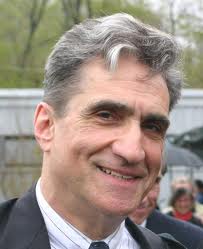
The one public event of the past month was an appearance at the New England Institute of Art in Brrookline. To arrange the reading, my Cambridge/Boston friend Jason Roush had put me in touch with David Blair, who teaches creative writing there and we agreed on a May 24th date.  I got to Boston shortly after eleven on that day and walked outside South Station to where Robert Pinsky, a friend for more than three decades now, was expecting me in his black car.  He looked well, and off we drove to for lunch in Cambridge at a Taiwanese place Robert said the novelist Ha Jin had recommended to him.  I always enjoy seeing Robert, partly because of his quick, warm intelligence and partly because it’s a pleasure to know someone generally recognized as among the very small number of world-class American poets of our era.  If his name doesn’t appear on the roster of Pultizer, NBA, or NBBC prizewinners, that’s not the fault of his work.  He has just published a magisterial Selected Poems, which, even so, I told him I found too severely pruned. I’d have preferred a more inclusive volume, but he reminded me that the earlier books are all in print, and said he wanted to put out an affordable book that would serve as an introduction to new readers.  Fair enough.

Robert Pinsky

To reread his startlingly original work for me is to relive my experience as a poet going back nearly four decades.  Robert’s first book, Sadness and Hapiness appeared in 1976, the same year as mine (titled All Roads at Once).  The YMHA in New York had in those years a program called “Introduction,” whereby four books were chosen by senior poets as the best first books of the year. The 1976 poets were Tess Gallagher, Maura Stanton, Robert, and myself. We were all invited to read at the Y, and that was the occasion when Robert and I first met. I immediately recognized him as an important new talent, and wanted to be his friend. Actually, I wrote a detailed review of his second book, An Explanation of America (collected later in a book of essays titled The Metamorphoses of Metaphor).  And then in the 90s, I wrote a review of The Figured Wheel, which was Robert’s first collected poems.  Over the years, we’ve kept in touch and I remember many glowing reunions, beginning with an evening dedicated to American poetry at the White House during the Carter Administration.  That’s when I met Ellen, to whom Robert is married. I also recall seeing him in Berkley, when he taught there, and in Oklahoma, when I was teaching at the U. of Tulsa, and he was the featured poet in the Cimarron Review literary festival.  Another time I called on him at his summer place in Truro.  I’ve also attended many readings of his, and we’ve met in Boston a couple of times.  I don’t know how Robert keeps on the go as much as he does. Apart from his writing, he gives several readings every month, keeps in touch with the Favorite Poem Project (which he launched when he was Poet Laureate), and teaches writing at B.U.  For a couple of years now, he has been giving poetry readings accompanied by a jazz combo, a format that was popular among the Beat poets back in the 1950s, but then became rare: the Rebirth of the Cool in the 21st century, we might say.  Robert is also poetry editor at Slate magazine, where he emcees online forums about classic poems.  As one of the few contemporary poets who has a regular doctoral degree in English lit (his grad school mentor was Yvor Winters), Robert knows the tradition very well and has a special affinity for Renaissance figures like Fulke Greville and the 19th century poet Landor, about whom he write an engaging critical book.  

He seemed glad for me that the spinal operation was a success.  We talked about mutual friends, discussed new books, exchanged a few jokes. And that was our meeting. He dropped me off near Harvard Square, as I had some free time before the next appointment.  I strolled around the Square, noting familiar landmarks, and dropped in at Grolier Books on Plympton Street to introduce myself to the new proprietor, a friendly woman named Carol Menkiti. Then it was time to go to Brookline Village, where Jason Roush was waiting for me.   I hadn’t seen Jason since March when he came to lunch in London (he makes an annual trip there during spring break).  Jason was introduced to this blog back in April of 2009, for those who want to look him up, and his books are available online at Amazon.  Teaching courses now at the NIE, he had planned for me to speak to one of them that afternoon, and so I did, a little surprised at how interested the students seemed to be. 

Next on the schedule was dinner with David Blair (author of a first book of poems titled Ascension Days), and Paul Rivenberg, who was putting me up that night.  After a good Venezuelan meal, it was time to go to the room at the NIE where I was to read.  Many students from the afternoon class showed up, and one or two faculty members, and Kevin Cutrer, whom I know from Facebook but had never met face to face. After the reading and a few books signed, I spoke to Tom Yuill, author of a first book titled Medicine Show. He studied with Robert Pinsky and Rosanna Warren and now teaches creative writing himself.

Next morning Paul and I had breakfast, and we talked until it was time for him to go off to work. Not long after, Jason arrived to spend the first part of the day together.  We walked to the Museum of Fine Arts, which I’ve visited many times of course, but I wanted to see the new wing, recently built to house the MFA's “Art of the Americas.”  A soberly handsome addition, faced with white marble interrupted by glazing in a faintly greenish tint.  Jason and I hit the high spots of the collection, familiar works like Sargent’s The Daughters of Edward Darley Boit, which seems to encapsulate the subject matter and tone of the Brown Decades, as recorded by Henry James, not to mention Howells, Wharton, and, elsewhere, Sargent himself.  I’ll also mention Copley’s iconic portrait of Paul Revere, a patriot suddenly in the news again because of Sarah Palin’s mixup about which side his lantern was giving a warning to during the famous midnight ride.  (One if by land and ignorant, two if by sea and scatterbrained.) Judging from Revere’s shrewd and steady gaze, I could well imagine what he might have felt before “refudicating” Palin’s various bloopers over the past few years. Still, as portrayed by Copley, the craftsman’s hands clasped the silver teapot he had made, his strong fingers (with the sort of attention to detail we associate with Vermeer) perfectly reflected in its polished surface.   
 
 
Paul Revere, by John Singleton Copley

Monday, 21 March 2011

A Season Summarized


Once again I’ve neglected for a long time to post anything here, part of the explanation being that I was caught up in so many activities I didn’t stop to think about writing about them.  Highlights would have included attending, with Marina Warner, a play titled Tiger Country, by the new playwright Nina Raine, whose father Craig Raine, the poet and critic, also a professor at Oxford, I met many years ago at Amy Clampitt's apartment in New York.  The play is set in a large London hospital and presents some of the difficulties of any such institution working under current rules established by the National Health Service. 

Other plays seen: a revival of Noël Coward’s playlet Red Peppers, followed by his short play Still Life, at Pentameters Theatre, which will produce my play Lowell’s Bedlam this April. Also, Lillian Hellman’s The Children’s Hour, at the Comedy Theatre, whose cast included stars Ellen Burstyn ad Keira Knightley. 

Sean O'Brien
As for seeing poet friends, I attended a Poetry Review launch at the Free Word Centre, which featured Sean O’Brien, reading, along with a young poet named Karen McCarthy Woolf.   I hadn’t seen Sean since last summer in Newcastle, and, regrettably, Gerry Wardle didn’t come down this time. Many poets were in the audience, including Poetry Review editor Fiona Sampson, of course, Elaine Feinstein, and Ruth Fainlight. After his extraordinary reading, Sean and I went out to dinner at an Italian place in Exmouth Market, joined by poets Alan Brownjohn, Leah Fritz,  Tamar Yoseloff, and her husband Andrew Lindesey.  I hadn’t met Brownjohn before, but we got onto the topic of Robert Lowell, whom he met during the years Lowell was married to Caroline Blackwood and indeed visited them at Maidstone, Kent.  Sean was in a convivial mood during dinner, leaving us all in compulsive laughter with his ironic asides.  The publication of his next book November (paradoxically published in April) should be one of the main literary events of the coming months.

Adam Mars-Jones
Adam Mars-Jones and I saw the Thomas Lawrence exhibition at the National Portrait Gallery, an occasion to speculate again why portraiture is the special excellence of British painting.  Maybe something to do with theatre, which has a preëminent place in British literature: the study of character, also carried out in fiction using techniques borrowed from drama. Consider, too, the dramatic monologue, brought to perfection in Browning's poetry.  After having tea, Adam and I walked to Foyle’s and there was a copy of his new novel, titled Cedilla, a sequel to the first volume Pilcrow, published a couple of years ago.  It continues the narrative of a disabled gay man, the story based on the life of a friend of Adam’s.  An original subject, told, surprisingly, with a lot of wit, verbal acuteness, and mischief.    

Invited by Kathryn Maris, I attended the award ceremony for the T.S. Eliot Prize, held this year at the Wallace Collection (not in the galleries themselves, but in the covered courtyard).  You can never say much at these gatherings, but at least it was a chance to greet poet friends like Don Paterson, Elaine Feinstein, Colette Bryce, and Ruth Fainlight, and to meet for the first time Robin Robertson and Lavinia Greenlaw.  Anne Stevenson, the head of the prize committee, announced that the winner was Derek Walcott (not present), and discussed the virtues of his magisterial collection White Egrets.  I spoke to Anne afterwards, and we calculated that we hadn’t seen each other since 1986, at a time when she was still living in here London, in Belsize Park.  That’s how, insensibly, a quarter century can pass. 

The Queens College, Oxford
I made a day trip to Oxford, planning to see David Constantine and Craig Raine. A telephone mixup meant that I missed Carig, but David and I had a pleasant hour around teatime, and the trip was also a chance to revisit what is no doubt the most beautiful assemblage of academic buildings in the world.  That would include David’s Queens College, one of Hawksmoor’s most resplendent designs.  

Don Paterson
A week or so later, I attended a reading at the London Review Bookshop, featuring Don Paterson, Jo Shapcott, and David Harsent.  By chance I ended up sitting with Fiona Sampson, with whom it’s always a pleasure to discuss things. Don gave a topnotch reading, and next day he and I had lunch at a Spanish place near King’s Cross and had a chance to catch up.  These days he is writing critical prose as well as poems, in fact, a couple of months back I reviewed his recent commentary on the Shakespeare sonnets (see the online journal Thethe):

http://www.thethepoetry.com/2011/02/marriage-counseling-for-true-minds/

Marilyn Hacker
Mimi Khalvati has come to dinner a couple of times, and I had Marilyn Hacker here to lunch when she came here from Paris, where she now lives. Marilyn was one of the readers for  the spring Poetry London launch, on her way the following morning to the Stanza Festival up at St. Andrews, Scotland. Marilyn has the distinction of being one of the very few American poets published abroad in France as well as the U.K.


I mentioned the upcoming production of my play Lowell’s Bedlam and am happy to announce that rehearsals for it have now begun.  The cast is as follows:

                                                    Theresa Brockway              Celeste Haydon
Lowell
Lowri Lewis                     Elizabeth Hardwick
David Manson                    Robert Lowell               
Hannah Mercer             Elizabeth Bishop               
Roger Sansom                    Dick Jaffee                    
 

The director is Daniel Ricken, and the producer is Leonie Scott- Matthews.

Bookings can be made at http://www.pentameters.co.uk/index.html

Thursday, 30 December 2010

London Continued


Pasolini
To wind up the year, a brief summary of whereabouts and events.  I got to London in mid-November and have spent the last month and a half settling in. I’ve seen friends, beginning with Kathryn Maris and her husband Herman Dietman, who put me up for a couple of nights when I first arrived.   At Kathryn’s suggestion I attended a performance of a Pasolini play, translated by the poet Jamie McKendrick as Fabrication, and performed at a fringe theatre in Notting Hill called The Print Room.  Afterward, Jamie gave a reading and answered questions.  We spoke briefly at the end, a chance to renew acquaintance after a hiatus of a couple of years. From there Kathryn and I went to a launch party for Anne-Marie Fyfe’s new book, titled Understudies, and recently published by Seren.  A big party, so there was no chance to do more than greet and congratulate Anne-Marie, and to listen to her read from the book. 

I’d seen Ruth Fainlight at the launch party and a week later went to have tea with her at her place in Notting Hill.  We tried to recall the circumstances of our first meeting and dated it back to 1987, during my second long-term stay in London. It was a dinner party with the novelist Madison Smartt Bell and his wife the poet Elizabeth Spires.  Ruth came with her husband Alan Sillitoe, whose novels I’d read, though I didn’t in those days know about Ruth’s poetry.  She has just now published her New and Collected Poems with Bloodaxe. Because of that event and Alan’s death this past spring, it’s likely that 2010 will have proved a pivotal year for Ruth.


Mimi Khalvati
Reform Club, Pall Mall
I saw Mimi Khalvati, in fact, attended a reading she gave at the Reform Club on Pall Mall. Mimi looked wonderful, and I gather that she is receiving a lot of favorable attention these days. The Reform Club is an immense building, constructed just at the beginning of Victoria’s reign by affluent Whig political figures.  We walked up the stone steps and into a vestibule, where we were met by Mimi’s contact person Mary Louise (sorry, didn’t hear the last name).  Another stone flight up to the central atrium, some three storeys high, with dark, gold-fluted columns topped by Corinthian capitals placed at decoratively strategic points around the hall.  Under a central mirror at the rear, a marble bust of Victoria, gazing towards her left.  Portraits of notable Liberals are placed in convenient niches around the atrium, for example, Palmerston, Gladstone, and others with names less recognizable.  Mimi and I went upstairs under Mary Louise’s guidance and had a quick survey of several rooms off the central atrium—a dining room, a library, a reading room.  The evening’s event was to be held in a large reading room on the second level. We drifted in and settled near the fire, the chimneypiece boasting a bronze head of Lloyd George. People began to trickle in, taking the little gilt ballroom chairs that had been set up.  Mimi was introduced and then read, very winningly, might I add.  After the final poem, applause, then people gathering round to congratulate her and buy a book.  And that was it.  We reclaimed our coats and put them on in the vestibule, where I noticed a strange, highly polished brass object.  I asked the doorman what it was and was told it was a cigar-lighter, no longer used but still in operation as late as the Second World War, when figures like Churchill made use of it.  Apparently there had been a gas flame in it accessible through an aperture where you inserted the cigar.  The only such object in the world? Very possibly.

From there we walked to a nearby Lebanese restaurant and had a pleasant dinner, a chance to catch up on each other’s news.  A few days later, we both participated in a marathon reading as a benefit for The Long Poem magazine at a café near King’s Cross.  Our bit done, we walked to a nearby restaurant and had dinner.  Many topics touched on, including the fact that Mimi’s new and selected poems are now in production and will be out next year with Carcanet.    

David Plante
I had dinner with the novelist and memoirist David Plante at his place in Marylebone, where I’ve often been a guest over the years. But this may be the last time I’ll have seen it, as he plans to move house very soon.  I met David here in London back in 1986, and we’ve been intermittently in touch ever since.  His partner Nikos Stangos, for many years an editor at Thames & Hudson, was also a dear friend, so there is, ever since Nikos’s death a few years ago, a touch of sadness when David and I reunite. He last year published a moving memoir about their relationship, Nikos’s illness and death, and its aftermath, titled The Pure Lover.  David was preparing to go to Lucca, where he has an apartment, for the Christmas holiday, but I expect to see him in 2011.  

Goldsmith
I’ve seen three plays, first, Goldy, based on the life and work of Oliver Goldsmith, staged by Pentameters Theatre in Hampstead (which will also produce my play about Robert Lowell this coming spring).  It’s an affectionate portrait of an underrated writer, from whose long poem The Deserted Village Tony Judt borrowed the title of his powerful last book Ill Fares the Land. To prolong the Augustan mood, I saw Sheridan’s The Rivals in the Peter Hall production at the Theatre Royal, a work seldom revived and performed this time with a lot of brio.  Not too many plays result in the coinage of a new word, but this one does. A “malapropism” is the term used to describe the verbal habit of the character Mrs. Malaprop, who confuses polysyllabic words, applying them in contexts where they don’t fit—as when she speaks of “allegories on the banks of the Nile.”  That tic and other comic elements produced a nefarious evening filled with knowing chuckles. Finally, with my friend Miguel Mansur I also saw the Young Vic production of The Glass Menagerie, which seemed only partly successful, yet had its moments. 
 

George Szirtes
Shortly after I settled in my sublet flat in Tufnell Park, George Szirtes, whom I hadn’t seen for over a year, came to lunch; and from there we went to Smith Square in Westminster for a cultural event George was scheduled to appear in. This was to be held in the recently established Europe House, the London headquarters of the European Commission, whose mission is, I believe, purely cultural.  At the door we were greeted by Jeremy Sullivan, who arranged the event and commissioned George’s poem.  We were guided into a small auditorium and there found Elaine Feinstein, dressed all in red and black.  She and I spoke as preparations for the evening were underway. Eventually people began coming in and one or two introductions were made, in particular, to Lázló Magócsi, the Science and Technology attaché to the Hungarian Embassy.  Naturally he wanted to speak with George, a British poet born in Hungary, yet the topics centered mainly on the scientific achievements of Hungarians in the 20th century, which are more considerable than I’d realized.

Europe House’s chief officer, a man named Scheele, launched the evening’s program. Then George read his commissioned poem, titled “The Door is Open,” concluding with this quatrain:

Here histories, manners, speech, vision, dance,
Commerce and custom, constitution, chance,
And strategy, seek concord and a voice.
Open the door. The house is yours. Rejoice.


After this, several ambassadors read poems in their language.  We had Austria, Poland, Denmark, Romania, Spain, Estonia, Belgium and, as mentioned, Hungary.  A translation was read after each poem, and then at the end Elaine read a few poems of her own (non-commissioned).  Applause, closing remarks, then drinks and snacks. Finally, there was a dinner party for participants and their guests, an occasion for interesting conversations with others present. George had a train to catch so we left a little early, I saw him to his cab and then walked to the tube, returning the same way I came.

James Byrne and Sandeep Parmar, back in London after several months in New York, came to call and have a look at my sublet for this year.  We had lunch here and engaged in an unbroken flow of talk about what we’ve been doing and writing.  Sandeep is teaching at Wagner College now and finishing her book on the Modernist British poet Hope Mirrlees. James has one more term at NYU before he gets his MFA and is putting the finishing touches on the next issue of The Wolf, expected in January. 

Marina Warner
Christmas roared in and out and on Boxing Day I walked to Kentish Town to attend a party given by my friend Marina Warner and her partner Graeme Segal.  I hadn’t seen Marina for quite a long time, so it was a pleasure to meet again.  I have very clear memories of her house because I once, back in 1987, rented it for four months.  Lots of changes have been made, so that seeing it now is like looking at a double exposure.  Marina introduced me to several people, all new to me. Then I had a brief conversation with her son, Conrad Shawcross, a rising young sculptor whom I hadn’t seen since he was a boy.  Conrad was on the eve of a month-long journey to India and Tasmania, which promises to be extraordinary.  Marina herself is completing a study of The Arabian Nights, a book I look forward to reading when it appears, as I do being her neighbor this winter and spring.  

For those interested in looking up publications, I have a review of UA Fanthorpe’s complete poems in the current Poetry Review. Also, under Sudeep Sen’s editorship, a long poem published in an online journal called Molossus. The poem’s titled “Eleven Londons” and describes my stays in this great city from 1967 to 2007. Here’s the link:

http://molossus.wordpress.com/2010/12/13/world-poetry-portfolio-7-alfred-corn/#more-1906


A happy New Year to all.