Wednesday, 8 June 2011

Rhode Island, Boston, and Robert Pinsky


Since returning from six months in London to the US in early April, I’ve had an outpatient operation to free a pinched nerve in the spine that was causing back and leg pain.  There needed to be some down time for recovery, and so, apart from physical therapy to regain strength, I haven’t done much here in southern Rhode Island except rest and make excursions to the seashore, never far away in the Ocean State.  People sometimes express curiosity as to why I live in the smallest of the fifty when I’m in the US and "smallest" is in itself part of the answer.  It seems I’ve come to adopt a contrarian approach to a lot of things. Why?  Because the standard m.o. for our supposed American dreams, goals and deeds, active for a century, has led us to the brink of failure as a nation. The American Way is to do everything on the biggest and most expensive scale possible.  
 
The representative American believes in cutthroat competition, getting rich (especially by bonuses), driving as fast and as rudely and dangerously as you can to shave ten seconds off a twenty-minute trip, the accumulation of as many toys as possible before one's expiration date. The fundamental attitude is, “Get out of the way, because I am the best.”  So for me small is good, just as non-competitive is good. I own practically nothing, neither house nor car, just a few books, CDs, clothes, and a computer.  I rent, I use public transport, and the public library. I don’t suffer from stress, and I don’t expect a lot of attention to be paid to me. Competition is the micro version of the macro wars that have become so popular lately as powerful individuals and nations of the world try to beat each other out of available goods and services instead of cooperating in a reciprocally interested way. The result hasn’t been good either for the modern West or for the exploited planet.  So why not take the opposite tack from what has been considered proper conduct and suitable aspiration up to now? Why not care less about conventional measures of success?  If we’re male, why not share power with women, and if white, with people of color?  Possibly we’d see some real improvement in the way things are going. To return to the micro level, it’s nice if I can write something that is topnotch, but it’s equally nice if someone else does. 

The one public event of the past month was an appearance at the New England Institute of Art in Brrookline. To arrange the reading, my Cambridge/Boston friend Jason Roush had put me in touch with David Blair, who teaches creative writing there and we agreed on a May 24th date.  I got to Boston shortly after eleven on that day and walked outside South Station to where Robert Pinsky, a friend for more than three decades now, was expecting me in his black car.  He looked well, and off we drove to for lunch in Cambridge at a Taiwanese place Robert said the novelist Ha Jin had recommended to him.  I always enjoy seeing Robert, partly because of his quick, warm intelligence and partly because it’s a pleasure to know someone generally recognized as among the very small number of world-class American poets of our era.  If his name doesn’t appear on the roster of Pultizer, NBA, or NBBC prizewinners, that’s not the fault of his work.  He has just published a magisterial Selected Poems, which, even so, I told him I found too severely pruned. I’d have preferred a more inclusive volume, but he reminded me that the earlier books are all in print, and said he wanted to put out an affordable book that would serve as an introduction to new readers.  Fair enough.
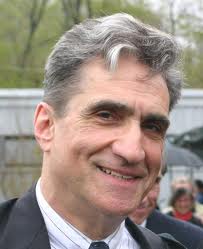
Robert Pinsky

To reread his startlingly original work for me is to relive my experience as a poet going back nearly four decades.  Robert’s first book, Sadness and Hapiness appeared in 1976, the same year as mine (titled All Roads at Once).  The YMHA in New York had in those years a program called “Introduction,” whereby four books were chosen by senior poets as the best first books of the year. The 1976 poets were Tess Gallagher, Maura Stanton, Robert, and myself. We were all invited to read at the Y, and that was the occasion when Robert and I first met. I immediately recognized him as an important new talent, and wanted to be his friend. Actually, I wrote a detailed review of his second book, An Explanation of America (collected later in a book of essays titled The Metamorphoses of Metaphor).  And then in the 90s, I wrote a review of The Figured Wheel, which was Robert’s first collected poems.  Over the years, we’ve kept in touch and I remember many glowing reunions, beginning with an evening dedicated to American poetry at the White House during the Carter Administration.  That’s when I met Ellen, to whom Robert is married. I also recall seeing him in Berkley, when he taught there, and in Oklahoma, when I was teaching at the U. of Tulsa, and he was the featured poet in the Cimarron Review literary festival.  Another time I called on him at his summer place in Truro.  I’ve also attended many readings of his, and we’ve met in Boston a couple of times.  I don’t know how Robert keeps on the go as much as he does. Apart from his writing, he gives several readings every month, keeps in touch with the Favorite Poem Project (which he launched when he was Poet Laureate), and teaches writing at B.U.  For a couple of years now, he has been giving poetry readings accompanied by a jazz combo, a format that was popular among the Beat poets back in the 1950s, but then became rare: the Rebirth of the Cool in the 21st century, we might say.  Robert is also poetry editor at Slate magazine, where he emcees online forums about classic poems.  As one of the few contemporary poets who has a regular doctoral degree in English lit (his grad school mentor was Yvor Winters), Robert knows the tradition very well and has a special affinity for Renaissance figures like Fulke Greville and the 19th century poet Landor, about whom he write an engaging critical book.  

He seemed glad for me that the spinal operation was a success.  We talked about mutual friends, discussed new books, exchanged a few jokes. And that was our meeting. He dropped me off near Harvard Square, as I had some free time before the next appointment.  I strolled around the Square, noting familiar landmarks, and dropped in at Grolier Books on Plympton Street to introduce myself to the new proprietor, a friendly woman named Carol Menkiti. Then it was time to go to Brookline Village, where Jason Roush was waiting for me.   I hadn’t seen Jason since March when he came to lunch in London (he makes an annual trip there during spring break).  Jason was introduced to this blog back in April of 2009, for those who want to look him up, and his books are available online at Amazon.  Teaching courses now at the NIE, he had planned for me to speak to one of them that afternoon, and so I did, a little surprised at how interested the students seemed to be. 

Next on the schedule was dinner with David Blair (author of a first book of poems titled Ascension Days), and Paul Rivenberg, who was putting me up that night.  After a good Venezuelan meal, it was time to go to the room at the NIE where I was to read.  Many students from the afternoon class showed up, and one or two faculty members, and Kevin Cutrer, whom I know from Facebook but had never met face to face. After the reading and a few books signed, I spoke to Tom Yuill, author of a first book titled Medicine Show. He studied with Robert Pinsky and Rosanna Warren and now teaches creative writing himself.

Next morning Paul and I had breakfast, and we talked until it was time for him to go off to work. Not long after, Jason arrived to spend the first part of the day together.  We walked to the Museum of Fine Arts, which I’ve visited many times of course, but I wanted to see the new wing, recently built to house the MFA's “Art of the Americas.”  A soberly handsome addition, faced with white marble interrupted by glazing in a faintly greenish tint.  Jason and I hit the high spots of the collection, familiar works like Sargent’s The Daughters of Edward Darley Boit, which seems to encapsulate the subject matter and tone of the Brown Decades, as recorded by Henry James, not to mention Howells, Wharton, and, elsewhere, Sargent himself.  I’ll also mention Copley’s iconic portrait of Paul Revere, a patriot suddenly in the news again because of Sarah Palin’s mixup about which side his lantern was giving a warning to during the famous midnight ride.  (One if by land and ignorant, two if by sea and scatterbrained.) Judging from Revere’s shrewd and steady gaze, I could well imagine what he might have felt before “refudicating” Palin’s various bloopers over the past few years. Still, as portrayed by Copley, the craftsman’s hands clasped the silver teapot he had made, his strong fingers (with the sort of attention to detail we associate with Vermeer) perfectly reflected in its polished surface.   
 
 
Paul Revere, by John Singleton Copley

Monday, 21 March 2011

A Season Summarized


Once again I’ve neglected for a long time to post anything here, part of the explanation being that I was caught up in so many activities I didn’t stop to think about writing about them.  Highlights would have included attending, with Marina Warner, a play titled Tiger Country, by the new playwright Nina Raine, whose father Craig Raine, the poet and critic, also a professor at Oxford, I met many years ago at Amy Clampitt's apartment in New York.  The play is set in a large London hospital and presents some of the difficulties of any such institution working under current rules established by the National Health Service. 

Other plays seen: a revival of Noël Coward’s playlet Red Peppers, followed by his short play Still Life, at Pentameters Theatre, which will produce my play Lowell’s Bedlam this April. Also, Lillian Hellman’s The Children’s Hour, at the Comedy Theatre, whose cast included stars Ellen Burstyn ad Keira Knightley. 

Sean O'Brien
As for seeing poet friends, I attended a Poetry Review launch at the Free Word Centre, which featured Sean O’Brien, reading, along with a young poet named Karen McCarthy Woolf.   I hadn’t seen Sean since last summer in Newcastle, and, regrettably, Gerry Wardle didn’t come down this time. Many poets were in the audience, including Poetry Review editor Fiona Sampson, of course, Elaine Feinstein, and Ruth Fainlight. After his extraordinary reading, Sean and I went out to dinner at an Italian place in Exmouth Market, joined by poets Alan Brownjohn, Leah Fritz,  Tamar Yoseloff, and her husband Andrew Lindesey.  I hadn’t met Brownjohn before, but we got onto the topic of Robert Lowell, whom he met during the years Lowell was married to Caroline Blackwood and indeed visited them at Maidstone, Kent.  Sean was in a convivial mood during dinner, leaving us all in compulsive laughter with his ironic asides.  The publication of his next book November (paradoxically published in April) should be one of the main literary events of the coming months.

Adam Mars-Jones
Adam Mars-Jones and I saw the Thomas Lawrence exhibition at the National Portrait Gallery, an occasion to speculate again why portraiture is the special excellence of British painting.  Maybe something to do with theatre, which has a preëminent place in British literature: the study of character, also carried out in fiction using techniques borrowed from drama. Consider, too, the dramatic monologue, brought to perfection in Browning's poetry.  After having tea, Adam and I walked to Foyle’s and there was a copy of his new novel, titled Cedilla, a sequel to the first volume Pilcrow, published a couple of years ago.  It continues the narrative of a disabled gay man, the story based on the life of a friend of Adam’s.  An original subject, told, surprisingly, with a lot of wit, verbal acuteness, and mischief.    

Invited by Kathryn Maris, I attended the award ceremony for the T.S. Eliot Prize, held this year at the Wallace Collection (not in the galleries themselves, but in the covered courtyard).  You can never say much at these gatherings, but at least it was a chance to greet poet friends like Don Paterson, Elaine Feinstein, Colette Bryce, and Ruth Fainlight, and to meet for the first time Robin Robertson and Lavinia Greenlaw.  Anne Stevenson, the head of the prize committee, announced that the winner was Derek Walcott (not present), and discussed the virtues of his magisterial collection White Egrets.  I spoke to Anne afterwards, and we calculated that we hadn’t seen each other since 1986, at a time when she was still living in here London, in Belsize Park.  That’s how, insensibly, a quarter century can pass. 

The Queens College, Oxford
I made a day trip to Oxford, planning to see David Constantine and Craig Raine. A telephone mixup meant that I missed Carig, but David and I had a pleasant hour around teatime, and the trip was also a chance to revisit what is no doubt the most beautiful assemblage of academic buildings in the world.  That would include David’s Queens College, one of Hawksmoor’s most resplendent designs.  

Don Paterson
A week or so later, I attended a reading at the London Review Bookshop, featuring Don Paterson, Jo Shapcott, and David Harsent.  By chance I ended up sitting with Fiona Sampson, with whom it’s always a pleasure to discuss things. Don gave a topnotch reading, and next day he and I had lunch at a Spanish place near King’s Cross and had a chance to catch up.  These days he is writing critical prose as well as poems, in fact, a couple of months back I reviewed his recent commentary on the Shakespeare sonnets (see the online journal Thethe):

http://www.thethepoetry.com/2011/02/marriage-counseling-for-true-minds/

Marilyn Hacker
Mimi Khalvati has come to dinner a couple of times, and I had Marilyn Hacker here to lunch when she came here from Paris, where she now lives. Marilyn was one of the readers for  the spring Poetry London launch, on her way the following morning to the Stanza Festival up at St. Andrews, Scotland. Marilyn has the distinction of being one of the very few American poets published abroad in France as well as the U.K.


I mentioned the upcoming production of my play Lowell’s Bedlam and am happy to announce that rehearsals for it have now begun.  The cast is as follows:

                                                    Theresa Brockway              Celeste Haydon
Lowell
Lowri Lewis                     Elizabeth Hardwick
David Manson                    Robert Lowell               
Hannah Mercer             Elizabeth Bishop               
Roger Sansom                    Dick Jaffee                    
 

The director is Daniel Ricken, and the producer is Leonie Scott- Matthews.

Bookings can be made at http://www.pentameters.co.uk/index.html

Thursday, 30 December 2010

London Continued


Pasolini
To wind up the year, a brief summary of whereabouts and events.  I got to London in mid-November and have spent the last month and a half settling in. I’ve seen friends, beginning with Kathryn Maris and her husband Herman Dietman, who put me up for a couple of nights when I first arrived.   At Kathryn’s suggestion I attended a performance of a Pasolini play, translated by the poet Jamie McKendrick as Fabrication, and performed at a fringe theatre in Notting Hill called The Print Room.  Afterward, Jamie gave a reading and answered questions.  We spoke briefly at the end, a chance to renew acquaintance after a hiatus of a couple of years. From there Kathryn and I went to a launch party for Anne-Marie Fyfe’s new book, titled Understudies, and recently published by Seren.  A big party, so there was no chance to do more than greet and congratulate Anne-Marie, and to listen to her read from the book. 

I’d seen Ruth Fainlight at the launch party and a week later went to have tea with her at her place in Notting Hill.  We tried to recall the circumstances of our first meeting and dated it back to 1987, during my second long-term stay in London. It was a dinner party with the novelist Madison Smartt Bell and his wife the poet Elizabeth Spires.  Ruth came with her husband Alan Sillitoe, whose novels I’d read, though I didn’t in those days know about Ruth’s poetry.  She has just now published her New and Collected Poems with Bloodaxe. Because of that event and Alan’s death this past spring, it’s likely that 2010 will have proved a pivotal year for Ruth.


Mimi Khalvati
Reform Club, Pall Mall
I saw Mimi Khalvati, in fact, attended a reading she gave at the Reform Club on Pall Mall. Mimi looked wonderful, and I gather that she is receiving a lot of favorable attention these days. The Reform Club is an immense building, constructed just at the beginning of Victoria’s reign by affluent Whig political figures.  We walked up the stone steps and into a vestibule, where we were met by Mimi’s contact person Mary Louise (sorry, didn’t hear the last name).  Another stone flight up to the central atrium, some three storeys high, with dark, gold-fluted columns topped by Corinthian capitals placed at decoratively strategic points around the hall.  Under a central mirror at the rear, a marble bust of Victoria, gazing towards her left.  Portraits of notable Liberals are placed in convenient niches around the atrium, for example, Palmerston, Gladstone, and others with names less recognizable.  Mimi and I went upstairs under Mary Louise’s guidance and had a quick survey of several rooms off the central atrium—a dining room, a library, a reading room.  The evening’s event was to be held in a large reading room on the second level. We drifted in and settled near the fire, the chimneypiece boasting a bronze head of Lloyd George. People began to trickle in, taking the little gilt ballroom chairs that had been set up.  Mimi was introduced and then read, very winningly, might I add.  After the final poem, applause, then people gathering round to congratulate her and buy a book.  And that was it.  We reclaimed our coats and put them on in the vestibule, where I noticed a strange, highly polished brass object.  I asked the doorman what it was and was told it was a cigar-lighter, no longer used but still in operation as late as the Second World War, when figures like Churchill made use of it.  Apparently there had been a gas flame in it accessible through an aperture where you inserted the cigar.  The only such object in the world? Very possibly.

From there we walked to a nearby Lebanese restaurant and had a pleasant dinner, a chance to catch up on each other’s news.  A few days later, we both participated in a marathon reading as a benefit for The Long Poem magazine at a café near King’s Cross.  Our bit done, we walked to a nearby restaurant and had dinner.  Many topics touched on, including the fact that Mimi’s new and selected poems are now in production and will be out next year with Carcanet.    

David Plante
I had dinner with the novelist and memoirist David Plante at his place in Marylebone, where I’ve often been a guest over the years. But this may be the last time I’ll have seen it, as he plans to move house very soon.  I met David here in London back in 1986, and we’ve been intermittently in touch ever since.  His partner Nikos Stangos, for many years an editor at Thames & Hudson, was also a dear friend, so there is, ever since Nikos’s death a few years ago, a touch of sadness when David and I reunite. He last year published a moving memoir about their relationship, Nikos’s illness and death, and its aftermath, titled The Pure Lover.  David was preparing to go to Lucca, where he has an apartment, for the Christmas holiday, but I expect to see him in 2011.  

Goldsmith
I’ve seen three plays, first, Goldy, based on the life and work of Oliver Goldsmith, staged by Pentameters Theatre in Hampstead (which will also produce my play about Robert Lowell this coming spring).  It’s an affectionate portrait of an underrated writer, from whose long poem The Deserted Village Tony Judt borrowed the title of his powerful last book Ill Fares the Land. To prolong the Augustan mood, I saw Sheridan’s The Rivals in the Peter Hall production at the Theatre Royal, a work seldom revived and performed this time with a lot of brio.  Not too many plays result in the coinage of a new word, but this one does. A “malapropism” is the term used to describe the verbal habit of the character Mrs. Malaprop, who confuses polysyllabic words, applying them in contexts where they don’t fit—as when she speaks of “allegories on the banks of the Nile.”  That tic and other comic elements produced a nefarious evening filled with knowing chuckles. Finally, with my friend Miguel Mansur I also saw the Young Vic production of The Glass Menagerie, which seemed only partly successful, yet had its moments. 
 

George Szirtes
Shortly after I settled in my sublet flat in Tufnell Park, George Szirtes, whom I hadn’t seen for over a year, came to lunch; and from there we went to Smith Square in Westminster for a cultural event George was scheduled to appear in. This was to be held in the recently established Europe House, the London headquarters of the European Commission, whose mission is, I believe, purely cultural.  At the door we were greeted by Jeremy Sullivan, who arranged the event and commissioned George’s poem.  We were guided into a small auditorium and there found Elaine Feinstein, dressed all in red and black.  She and I spoke as preparations for the evening were underway. Eventually people began coming in and one or two introductions were made, in particular, to Lázló Magócsi, the Science and Technology attaché to the Hungarian Embassy.  Naturally he wanted to speak with George, a British poet born in Hungary, yet the topics centered mainly on the scientific achievements of Hungarians in the 20th century, which are more considerable than I’d realized.

Europe House’s chief officer, a man named Scheele, launched the evening’s program. Then George read his commissioned poem, titled “The Door is Open,” concluding with this quatrain:

Here histories, manners, speech, vision, dance,
Commerce and custom, constitution, chance,
And strategy, seek concord and a voice.
Open the door. The house is yours. Rejoice.


After this, several ambassadors read poems in their language.  We had Austria, Poland, Denmark, Romania, Spain, Estonia, Belgium and, as mentioned, Hungary.  A translation was read after each poem, and then at the end Elaine read a few poems of her own (non-commissioned).  Applause, closing remarks, then drinks and snacks. Finally, there was a dinner party for participants and their guests, an occasion for interesting conversations with others present. George had a train to catch so we left a little early, I saw him to his cab and then walked to the tube, returning the same way I came.

James Byrne and Sandeep Parmar, back in London after several months in New York, came to call and have a look at my sublet for this year.  We had lunch here and engaged in an unbroken flow of talk about what we’ve been doing and writing.  Sandeep is teaching at Wagner College now and finishing her book on the Modernist British poet Hope Mirrlees. James has one more term at NYU before he gets his MFA and is putting the finishing touches on the next issue of The Wolf, expected in January. 

Marina Warner
Christmas roared in and out and on Boxing Day I walked to Kentish Town to attend a party given by my friend Marina Warner and her partner Graeme Segal.  I hadn’t seen Marina for quite a long time, so it was a pleasure to meet again.  I have very clear memories of her house because I once, back in 1987, rented it for four months.  Lots of changes have been made, so that seeing it now is like looking at a double exposure.  Marina introduced me to several people, all new to me. Then I had a brief conversation with her son, Conrad Shawcross, a rising young sculptor whom I hadn’t seen since he was a boy.  Conrad was on the eve of a month-long journey to India and Tasmania, which promises to be extraordinary.  Marina herself is completing a study of The Arabian Nights, a book I look forward to reading when it appears, as I do being her neighbor this winter and spring.  

For those interested in looking up publications, I have a review of UA Fanthorpe’s complete poems in the current Poetry Review. Also, under Sudeep Sen’s editorship, a long poem published in an online journal called Molossus. The poem’s titled “Eleven Londons” and describes my stays in this great city from 1967 to 2007. Here’s the link:

http://molossus.wordpress.com/2010/12/13/world-poetry-portfolio-7-alfred-corn/#more-1906


A happy New Year to all.

Thursday, 18 November 2010

Multiple genres

This blog seems to have become intermittent only, and I can guess the reason. Since I went on Facebook, it’s come to seem easier to post updates and thoughts there than here. So I invite people to join me on Facebook if they’d like to keep in touch.


The preceding blog records my visit to Scotland, but not the two weeks in London following it. It seems a little late now to report on that, even though I so much enjoyed seeing my friends there. I left London in mid-September and stayed in southern Rhode Island for the past two months. There was a knee operation that needed attending to—nothing grave, just a meniscus tear. Recovery went smoothly and in October I went down to New York to see friends, staying with Walter Brown, who has appeared here in earlier posts. Among the friends I saw was Edmund White, the novelist, and his partner Michael Carroll, also a fiction-writer. I’ve known Edmund since late 1966. In those days he worked for Time-Life Books as a staff researcher and writer, and I was then a grad student at Columbia in French. He had had a play produced Off-Broadway but hadn’t published a novel yet. For some reason he found both myself and Ann Jones, with whom I was then living, worth befriending. I had no publication credits to my name, but eventually confessed to him that I wanted to be a writer. I found him brilliant and funny, and he was one of the few people out as a gay person. Of my friends, only Ann knew about my own sexuality, which she had accepted without shock or embarrassment.


Edmund had written an autobiographical novel, which I read and liked. Still I was busybody enough to urge him to look into the French nouveau roman, in other words, to be more experimental. Like all beginners, I thought the avant-garde was the only worthwhile approach to the making of art. It isn’t a nouveau roman, but his first novel Forgetting Elena is certainly not a realist-naturalist work, and it remains among his most intricate and brilliant. During the composition of it, he read individual chapters to Ann and me, and we cheered him on. Possibly for that reason, the dedication page has our name on it.


There have been periods when we didn’t see each other; also, he lived for many years in Paris, where I nevertheless did visit him at his Ile St. Louis apartment. After that he also taught for a couple of years at Brown and I visited him in Providence once. Eventually we do always re-establish contact, and so it was this visit. I went to his place on Twenty-Second Street, a reunion laughter-filled as so many others have been. We spent a couple of hours catching up, and I have to say that Ed is a fascinating source of news and insight about mutual friends as well as people whose names I know even if I haven’t met them. He has just completed a new novel titled Jack Holmes and His Friend, and I’ve begun reading it in manuscript. It resembles the novel I read back in the 1960s, which means Ed has come full circle. Whether it qualifies as avant-garde I doubt, but I no longer care. It hardly makes sense to insist, in the name of artistic freedom, that only one approach is permissible in the production of new works.


In 1970, Edmund introduced me to Richard Howard, whom I’ve kept in touch with intermittently ever since. In the first years of my friendship with Ed, I was entirely absorbed in writing fiction. It was really my friendship with Richard that led me back to writing poetry. He was helpful with my early, unreadable efforts, giving me books to read and responding tactfully to what I showed him. I never signed up for an MFA program (quite a rare career path in those days), but Richard, along with the critic David Kalstone, to whom he introduced me, became something even better than a substitute for that. They offered informal instruction and encouragement. Richard in his capacity as poetry editor published some of my earliest poems. Not long after, Ed was named editor of The Saturday Review and published poems and almost my first critical essay. Without these friends, I doubt I would ever have made my way as a writer.


I saw Richard during the New York trip, smiling, unruffled by and fully recovered from some recent age-appropriate health problems. I recall dozens and dozens of visits to his book-lined rooms on Waverley Place in the Village. From there we walked to a nearby restaurant for lunch. Richard has reached something like philosophical acceptance about the death earlier this year of his close friends Sanford Friedman and Ben Sonnenberg. As for himself, he is busily engaged in teaching in the graduate writing program at Columbia, where I taught off and on in the years 1983-2001. He was working on a review and a translation, something to add to a staggering bibliography of poetry, critical writing and translated work. I wouldn’t call him a man of letters so much as a Hercules of letters. His conversation is like no one else’s, filled with references to literature and art (he seems to have read and seen everything), including all writers of note in the present century. Because we have so many friends in common, we were able to bring each other up to date on them and comment on the changes the time inevitably brings. It was difficult to stand and go; I felt we easily could have talked another several hours. But there was work to do. My plan is to schedule another meeting on first opportunity.


I write poetry. I write fiction. I write criticism. I see all three as related projects. But less attention has been paid to what I’ve done in the prose. There seems to be an almost invincible prejudice against poets who publish novels, perhaps a little less when they publish stories. A review of a poet’s novel never fails to say, “This is a poet’s novel,” whereby the reader is relieved of any expectation that s/he might enjoy it. And there is the feeling among imaginative writers that when you write criticism, you have somehow gone over to the enemy. I don’t think so. Rather than argue, let me list a few names: Coleridge, Hardy, Lawrence, Eliot, Randall Jarrell, Elizabeth Bishop. And of course many, many more.

Tuesday, 31 August 2010

Edinburgh and the Highlands

I'm trying to make up for my scarce writing here this summer, now that the summer break has ended. This entry has to do with Edinburgh, one of my favourite cities, partly because of its unusual beauty and partly because my great-grandfather was born there.

Paul Attinello and I took a train from Newcastle on Saturday with the plan of attending the Meredith Monk performance in the annual Festival. On arrival, we had a few hours and strolled up to Calton Hill, which gives a view of Arthur’s Seat (highest of the crags next to Holyrood Palace), the lower city and the crag where Edinburgh Castle sits. The familiar sensations of my day trips into Edinburgh last May (see earlier blog posts) came rushing back, but of course the streets were now much more crowded with Festival goers. Once we got to the center, we decided there was time to see one of the Fringe shows before the evening’s performance and settled on the Do Theatre, a troupe of Russians who now live in Berlin, in a work titled The Anatomy of Fantasy. This was being held at the Assemby on George Street, where we continued on foot.


The title suggests the mode of the work—dreamlike evocations of an underworld of obscure events, danced to a varied collage of musical accompaniment. Thematic visual elements included lengths of red string deployed in various ways, four scythes, ashes, three movable windows with venetian blinds, and a steel-frame cube. Two principals, male and female, three female secondary dancers, and the musician made up the troupe. Recorded music was used along with additions from the musician who from time to time used his boot heels to provide percussion. Smoke billowed more than once, and the rhythms twice became very loud and insistent. Meaning? Let’s say that many interpretations could be tried, probably none of them accounting for every detail. The interpretation of dreams asks for high levels of Keatsian negative capability. The “erotics” of criticism, not the hermeneutics, as Sontag once urged.


The Monk performance began at eight, and to what looked like a full house. Title: Songs of Ascension. A bare stage with a single suspended glass lamp making wide circles while a woman in a white dress moved about and informally danced. Slowly the lamp rose in proportion as its circles shrank, finally vanishing up into the flies. Then the performers, including Meredith Monk came out. That included her co-perfomer Ching Gonzalez, who has apeared in many Monk works. Two violins, a viola, and a cello, which the cellist several times played while standing and holding it. A chorus joined in many times, concluding in the angelic location of two boxes on opposite sides of the hall. The music used mostly pandiatonic harmony, with an occasional chromatic touch. It owes something to the “Minimalist” style of Glass and Reich and perhaps a little to Virgil Thompson, but mostly it is Monk’s own language, especially for the vocal lines, which use little calls reminiscent of Native American singing. To which she adds serrated melodic motifs, little tonal peaks and valleys something like medieval hocketing. Though of course there was also some conventional vocal leading. The overall effect was ecstatic, with occasional somber or humorous asides. A rising climax at the end earned the piece’s title. Is there a word better than “inspiring” or “uplifting” that I could use to describe it?


Paul and I went to the stage door and eventually the artist of the evening emerged and smiled delightedly to see Paul (they’ve known each other for many years), who embraced and congratulated her. I was duly introduced and had a friendly greeting from both Meredith and Ching Gonzalez. She said they were going to a party and invited us to come if we liked. There was even a van to drive us there. So in we rode through the Grass Market up to Princes Street and around to the High Street, the final destination the large Victorian building of the City Chambers. Up a flight of stairs and past vitrines with historical memorabilia, including a small silver replica of the Walter Scott Monument on Princes Street. I’d assumed it would be a party given by some private person, but, no, it was a City of Edinburgh event. Artists performing several different shows that evening gathered in the Council Chamber, a large, high-ceilinged hall with coffers in its ceiling, brass chandeliers, and a series of mural paintings by William Hole based on Scottish history. “Mary Queen of Scots Enters Edinburgh,” “News of the Battle of Flodden,” “Robert the Bruce Presents a Charter to the Burgesses of the Town,” and so on. Wine was immediately available and taken. The Lord Provost and his wife were there, and soon enough he shifted into action and welcomed everyone. He wore an ornamental chain of office around his neck (in fact, so did the Lady Provost), even more elaborate than what you see depicted in the Holbein painting of Thomas More, the one now hanging in the Frick Museum. A touch of the ceremonial past. Then Jonathan Mills, Director of the Festival, spoke with an informality that matched his clothes, and after that food was served.


We had our meal, mingling with all the performers and groups that had gathered for the party, and then said goodnight.


Next morning I got up early and took a cab over to the High Street, where a bus waited for my tour of the Scottish Highlands. Although bus tours are in most ways awful, I’ve waited too long to see that part of the world, somehow never quite managing to get there using more comfortable modes of transport. Anyway, I think of it as a reconnaissance mission, during which I would learn what parts of the country I’d like to return to.


A guide (in obligatory tartan kilt) kept up a running monologue about the places we were passing, beginning with Georgian Edinburgh and some of its famous figures. Before long we’d left the city behind and began to see sights. The Forth Bridge, for instance, an early engineering feat still in use today. Loch Lieven with a castle on its little island. Perth, formerly St. Johns Town, which coined its name from Roman Apertha as soon as Presbyterianism made popishness like saints unacceptable to the new sect. A mention of Scott’s The Fair Maid of Perth, based on the life of Catheirne Glover whose house is still there to be visited. A quick passage through Birnam Wood, no less, although Dunsinane was too far away to be visible. And so on until the first big ridge of the Highlands appeared. Nine hundred million years old, according to our guide, but then other parts of farther north were 4000 million years old. Age seems to make for beauty because the landscape began to take on a majestic allure. Empty except for a few sheep, with whin and purple heather covering the stony, uncultivated land. (Whin being a heather-like spiky shrub that grows near whinstone or basaltic rock.) We passed several whiskey distilleries, looking not very industrial but presumably producing huge quantities of the famous local product. Then came a hallucinatory series of rainbows, complete, transport-worthy bridge arches, some of them double. They backed away as we moved toward them, constantly replacing themselves, as in a slide show. Before long Ben Nevis was in view, its top lost in cloud. Britain’s tallest mountain, but today looking like something in a Chinese painting. Tall as it is, the guide said, there is a path that allows you to reach the summit in about two hours without a lot of difficulty. I’d like to do that some day.


Pitlochry, for a, shall we say, “pit stop.” Long queues at the cafés for coffee and buns. A surrounding amphitheater of surrounding mountains. Sunlight gleaming off the pavement and rain droplets, cold winds. Back on the bus. Onward through more rainbows. Evergreens, reforestation of land that long ago was cut and burned. Higher mountains. Loch Lochie, part of the North Scotland canal. Leading to Loch Oich and a series of intermediate locks. Finally Fort Augustus, at the western end of Loch Ness, where we stopped for lunch. Some took a boat out onto the lake. I didn’t, despite the realization that one doesn’t see much of Loch Ness from its western extremity. I had my packed lunch on a bench facing the Loch, watching the tourist boat retreat and retreat towards distant waters and mountains. Canoe trippers coming from Loch Oich, not wanting to pay for the locks, had to make a portage through town. Lunch consumed, I rinsed my hands in the stingingly cold water. After which, a stroll back to the locks and up the stair at each level to the top one, for a glance westward where boats were beginning to gather for the next trip down the water stairs provided.


The return took a more westerly route so that after seeing Ben Nevis from another angle, we would see a different part of the Highlands. The most staggering was the country around Glencoe, in the west, where you get lochs that are actually fjords connecting to the Atlantic. The mountains thrust vertically up and yet are rounded by erosion, with green slopes most of the way to the summits. It is Ossian country and his cave was pointed out to us as we sped past, dazed by all the sublimity. It is the ideal place for the Romantic movement to have been born.


Next morning I checked out of the hotel and made my way over to Charlotte Square, where the Edinburgh Book Festival is being held this year. Literally in the Square: tents and wooden walkways have been set up in the middle of the central green, and that’s where events take place. I’d told Don Paterson I’d come to his reading at 11:30 and so I did. The venue was a large space with probably three hundred seats and there must have been about 250 people in the audience. (I guess they weren’t aware of the commonplace notion that “No one is interested in poetry.”) The Festival Director, Nick Barley, gave a rather odd intro, then Don came to the lectern wearing a black suit jacket and white shirt, his white beard neatly trimmed. He had a glass of wine with him to help him deal with a slight cough, he said. Sips of this throughout the reading gradually warmed him up, so that the tentative modesty of the beginning was gradually replaced by something a little bolder and more spirited. He has an appealing Dundonian voice and is able to make use of Scottish intonations you might not have guessed at if access to the poems came only through the page. There’s also a habit of placing one foot in front of the other and rocking back and forth in response to the verses, occasionally lifting the back foot. Possibly a remnant from his days as a rock music performer? He read mostly from the recent collection Rain but a few new poems as well. The in-between comments were pointed and amusing, touching on many different topics. That includes his atheism, a skeptical stance that seems to be countered by a strong awareness of mystery—the mystery of being itself, just for a start. He also read a few aphorisms, which (should I be surprised?) were well received. I sensed he held the audience’s attention throughout; loud applause at the end suggested as much.


I strolled over to the London Review of Books tent café afterward to speak to him, where he was set up at a table on a low platform for book signing. Over a hundred fans were queued up for his signature. When the last had gone, I went up and gave his hand a congratulatory shake. Even though the aftershock of giving a large-scale reading hadn’t quite dispelled, we enjoyed a few minutes of gently ironic banter. He had other appointments, and I had a train to catch, so there was no question of lunch or even a coffee. Don plans to read at the 92nd St. Y in New York in October (yes, this is an ad for it), so possibly I’ll see him there when I get back.


So, a temporary farewell to Caledonia. And two days from now I leave Newcastle for London. But the images are still with me.


Friday, 27 August 2010

North-South Shuttle

Summer is the season to slack off from work, and that’s been true for me as to this blog; and not true for poems, fiction, and critical prose. I was down to London again in July to read with several other contributors to Mimi Khalvati’s anthology of fado songs mentioned in an earlier entry. This time I stayed in a hotel in Bloomsbury, making plans the first afternoon to spend some time with Margo Berdeshevsky, who’d come over from Paris for a couple of nights. Margo and I got to know each other through mutual friends Marie Ponsot and Marilyn Hacker. She has published one book of poems with Sheep Meadow and a second is now in production. Earlier this year she published a well-received collection of short fiction with the Fiction Collective, and she also makes fascinating photographic art, superimposing images from different contexts to make a new whole. Margo is a native New Yorker who had a successful stage career for many years, which she eventually relinquished in order to go and live in Hawaii, shifting her interest then to poetry. Our first meeting was a workshop I taught in the early 90s at an Arts Center in Maui, but we only became friends during the past five years. She now lives in Paris, in what I’d call an ideal apartment in the Marais, just opposite the Hôtel Carnavalet, once the Paris residence of Mme de Sévigné.


She and I attended the first part of the launch of the Summer issue of Poetry Review, partly because I had a poem in it and partly because I wanted to hear Ruth Padel, the evening’s featured reader. I first met Ruth when we were both participants in the San Miguel Poetry festival in Mexico, in late 90s. I hadn’t known about her work at that time, but, since then, she has become of the leading poets in Britain. She gave a brilliant reading at the launch, so it was too bad I couldn’t stay to congratulate her; I had the launch of Mimi’s anthology to do the same evening.


That was held at the Free Word Centre in Clerkenwell. When Margot and I got there, the first person I saw was Mimi, looking particularly attractive, and modestly aglow about the festivities soon to begin. The Free Word Centre had been set up like a cabaret, with low lighting and three separate stages, one of them high up on a balcony overlooking the space. During the general mingling beforehand, I saw several friends, including Michael Schmidt, the poet and editor, and one of the contributors scheduled to read. We first met in the 80s, and there have been several meetings since then, to the extent that a man who runs a large publishing house, edits a magazine, teaches writing, assembles anthologies and writes poetry and poetry criticism, can spare time for meetings. Then Marilyn Hacker arrived and we had a quick conversation in the last few minutes before proceedings began. Other participants were Eric Ormsby, to whom I spoke briefly and Pascale Petit, whom I hadn’t seen for several months. I was also pleased that Sophie Mayer, fellow resident at Hawthornden, last May had come.


The readings were done in three sets, concluding with Mimi giving a beautiful rendition from the balcony. After that, actual Portuguese fado performers came to the main stage and performed several songs for us. Good as the translations in the anthology are, there is still no substitute for the original Portuguese, accompanied by music. I went up afterwards to congratulate Mimi on the evening and was introduced to Grey Gowrie, one of the contributors and in fact the originator of the idea for this anthology. Knowing that he had been a good friend of Lowell’s, I asked him what his impressions were. He spoke warmly of a poet he clearly regarded as his mentor and mentioned that it was through his intermediary that Lowell and Caroline Blackwood met for the first time, an encounter that eventually led to Lowell’s divorce from Elizabeth Hardwick and remarriage to Caroline Blackwood (aspects of this narrative are found in Lowell's The Dolphin). Acknowledging its negative aspects, Gowrie pointed out that the marriage had produced a fine son and that Elizabeth Hardwick’s work had gained fresh strength once she was on her own. Obviously these comments very much interested someone who has written a play about Lowell to be produced next year in London. (We still haven’t set a date, but I think it will probably be in March of 2011.)


Next morning I met James Byrne for coffee near his summer rental on Queen Square, a quiet enclave in Bloomsbury where the offices of Faber & Faber are located (though currently under renovation). James brought me up to date about his plans. He’ll be returning as a second year student at NYU’s writing school, as an International Fellow, editing The Wolf from over there as he did this past year. Meanwhile, he has been working on an anthology of Burmese dissident poets, scheduled for next year. We had a good hour’s stroll around the neighborhood and then said goodbye when I went off to my lunch appointment. The night before a plan had been made for Mimi, Marilyn, her friend the poet and critic Mary Bain Campbell, and myself to meet for lunch. Which we did, a pleasant couple of hours at a good Indian restaurant near Euston Station. Conversation was equal parts serious and hilarious, but I won’t attempt to summarize it. After lunch, Marilyn and I went down to the Blakean neighborhood of Lambeth, specifically, to Lambeth Palace, where there was an exhibition of medieval illuminated mss. Taken from the Lambeth Library, some of them of extraordinary quality and historical interest.


I came down to London once more in July, staying with my friend David Matthews, the vicar of Holy Innocents parish out in Hammersmith. David and I met through our mutual friend Edmund White, whose work he greatly admires. David is originally from Nova Scotia but is now pretty well at home in London, where he has many, many friends and seems to be adored by his parishioners. I’d wanted to attend an evening in honor of poets from the U.A.E. sponsored by Banipal magazine and held at the Purcell Room on the South Bank. David had other plans, but James Byrne met me there and we had a congenial reunion as we always do. There were Margaret Obank and Samuel Shimon, who edit Banipal, and London poets Stephen Watts and Yiang-Lin, a Chinese dissident now living and working in the U.K. The Emirates poets were Nujoom Al-Ghanem, Khalid Albudoor, and Khulood Al-Mu’alla, none of them known to me, but all highly accomplished, to the extent that it’s possible to judge from translation.


Next day evening, David and I joined Adam Mars-Jones and Keith King for dinner, and then they went off to a see a play. The plan was to rejoin them after at the launch of the new issue of Granta, where Adam often appears. We followed through, but apparently we arrived too late, after the festivities had ended. Still, it was a chance to exchange news with them, and I can see that they both are prospering.


I mentioned in the previous blog that I was to read at the Lit and Phil Society here in Newcastle (see picture at right), and that indeed took place late in July. An extra for me was that James Byrne came up to visit for a couple of nights and so was able to attend. Also attending were Sean and Gerry, Paul Attinello, and the fiction writer Chaz Brenchley. We all went out for a meal after, a good way to cap off the evening.


As for the outdoor aspect of the summer, I made an excursion with Alistair Elliot to two stately homes within driving distance of Newcastle, the first called Belsay. It’s a Doric Greek design built about 200 years ago (see above), severely elegant, and comprising a garden that was made in the quarry from which its building stone was taken. The result is a marvelous grotto filled with ferns and tall trees, not like anything I’ve seen before. Wallington was more familiarly Palladian neoclassical, though the interior was eventually made Victorian. Frequent visitors there were Macaulay and Ruskin, and its paintings include a Turner. All of this surrounded by a huge park with impressive views. Alistair has a sense of humor similar to mine, so I joked that, in the way English names are often pronounced differently from what the spelling would lead you to assume (for example, “Featherstone” is pronounced “Fanshaw”), the names of these two great houses were most likely pronounced “Besy” and “Wanton.” The surmise, however, awaits confirmation.


The other excursion I made was to Lindisfarne (called “the Holy Island” because it was the point of dispersion for Christianity in Northern England more than a thousand years ago). Sean and Gerry and I went there on a cloudy Sunday, the trip timed so that we would be sure to arrive at low tide, otherwise the causeway out to the island is under water. (It’s a feature I recall from a visit many years ago to Mont St. Michel, off the French coast.) The same is true of Mount St. Michael in Cornwall, but not true of Skellig Michael off the coast of Ireland: there you always must take a boat. Why St. Michael the Archangel should in the medieval period be associated with offshore islands I don’t know; but he doesn’t figure on Lindisfarne, instead, St. Cuthbert enjoys special reverence there, even though his remains were long after his death exhumed and removed to Durham Cathedral. It is also where the wonderfully illuminated Lindisfarne Gospels were produced. (See picture above left.)


I’d visited Lindisfarne in 1986, but it has grown and developed since then, with swarms of visitors everywhere, to whose number we sheepishly added ourselves. It is wildly beautiful, with views out to a clouded North Sea and inward to pastures with grazing sheep, the ruined priory, and perhaps twenty-odd stone houses. On a small crag near the water sits Lindisfarne’s castle, a ruin that was renovated and given modern convenience by Lutyens a century ago. It is easy to summon up images of invading Vikings, vulnerable as the place is to approach from the sea. To come here is to experience that little historical shiver our modern cities insulate us from.


This past week several friends came to me in North Shields, and we read our poems. The convives gathered were Sean, Alistair, Bill Herbert, and Joan Hewitt, a poet from Tynemouth whom I’ve only recently become acquainted with. Very lively indeed, and, as the last social occasion of my stay here, a good finale. I go to Scotland for the end-of-summer weekend, and then return in time to pack up. Even though this brief recap can’t do it justice, it’s one of the best summers I remember.


Monday, 5 July 2010

Northumbria and London

I’m spending the summer in North Shields, Northumbria, about twenty minutes from the town center of Newcastle upon Tyne. North Shields sits about sixty feet above the river, and from Tyne Street (two minutes from my door) you can see about a mile to where it empties into the North Sea. I’ve made the walk along the promenade to Tynemouth, a seacoast town noted for the ruins of an abbey on the edge of a promontory above the waves. (Stevens once wrote a poem titled “Cathedrals Are Not Built By the Sea,” but certainly this abbey was, as well as the one in Whitby.) Camera enthusiasts will find more than enough targets to aim at—the lighthouse at the end of the jetty, weathered Gothic arches overlooking old graves, and the North Sea itself, usually calm with clouds massed at the horizon.


Back in North Shields there are two main lighthouses no longer used for the original purpose, one on Tyne Street and a second lower down on Fish Quay, where boats come in to unload the catch of the day. Restaurants there take advantage of this fact, and there are a couple of fishmongers where you can find a wide range of seafood to buy. Off Tyne Street there is a little park on Dockwray Square with a commemorative statue at its center. Instead of the obligatory civic leader or admiral, you find a slightly cartoonish rendering of Stan Laurel, a choice that puzzled me until I was told that Laurel had lived in the square when he was a boy, from 1897 to 1902.


I go into Newcastle at least twice a week, taking the Metro train, which lets you out at Monument Square, at the foot of a column on top of which stands the statue of the 19th century statesman Earl Grey. The vista down Grey and Grainger Streets is breathtaking, a handsome neoclassical architectural ensemble in tan limestone (which includes the Theatre Royal, shown above right), not like any other cityscape I know. Novocastrians (people who live in Newcastle) may, however, be too used to it, not quite realizing how unusual and beautiful it is. If I were on the City Council, I would urge passage of an ordinance strictly limiting the kind of signage permitted on Grey Street, especially the dissonant TO LET signs that project out from façades overhead.


Not far from the railway station is the venerable Literary and Philosophical Society, founded in the 18th century as a private "conversation club," eventually a library and lecture hall. The Lit and Phil, too, is a handsome structure, completed in 1822,with a large interior atrium and library stacks on two levels. The public can use it as a reading room and members are allowed to borrow books. There are lectures and literary events year round, in fact, I will be giving a poetry reading there later this month.


Since arriving I’ve seen friends I got to know last summer, in particular, Paul Attinello who is in the Musicology Department at Newcastle University, the poet Sean O’Brien and his wife Gerry Wardle, and the poet Toby Martinez de las Rivas, who lives in Gateshead across the river. During my first week here, Sean gave a magisterial reading at the Newcastle Library, the first time I've heard him, and an experience not to be forgotten. He has a wonderful reading voice, and there were touches of humor, without the usual pandering to the audience for laughs that mars so many readings. Then, a week later, Toby and I attended a reading that the Irish poet Paul Durcan gave at Newcastle University. As we filed into the hall, Sean introduced me to the Scottish poet W.H. Herbert, who actually is my neighbor in North Shields. In the past weeks I’ve also met the poet Alistair Elliot, a Newcastle resident for many years. Alistair has had a widely varied life, beginning with the fact that he was one of the British children sent for safekeeping to America during the Second World War. By coincidence, Alistair’s American host was Charles Merrill, father of James Merrill, whom I knew well in the 1970s and 1980s. Alistair has published many books of poetry and is also known as a distinguished translator, his version of Medea enjoying successful productions here and in New York several years ago. Finally, I met the poet Peter Bennet, who lives out in the country to the west of Newcastle. By another coincidence his publisher is Newcastle’s Flambard Press, whose managing editor Will Mackie rents me the house where I’m staying here in North Shields.


I had planned several trips back to London over the summer and have already made one of them. Two weeks ago I went down and stayed a couple of nights with my friend Kathryn Maris and her husband Herman Dietman, who live near the Regent’s Canal in one of London’s prettiest neighborhoods. Kathryn published her first book with Four Ways Press, but her second is scheduled with Seren Books over here. I had come down to take part in a launch of the Summer issue of The Wolf, which has an interview with me, accompanied by two poems. Kathryn came with me to the event, which was held at the Poetry Studio, upstairs from the Poetry Café on Betterton Street. It was good to see James Byrne and Sandeep Parmar again, also, James’s mother Mary and her husband David Shuttle. My co-readers were Anne-Marie Fyfe, who has a strange and haunting poem in the issue, and a young poet named Richard Parks. Poets who were there included the Canadian Todd Swift, whom I hadn’t seen for more than year, and the American poet Dante Micheaux, whose first book is scheduled with Sheep Meadow later this year. After the launch we all went to an Indian restaurant on The Strand, there since the 1940s I was told, its former clientele purportedly including Gandhi and Nehru. We were probably twenty at table, and it’s accurate to say that a spirit of celebration was in the air, dispelling any idea of poetry as a pursuit only for the massively serious and over-earnest.


Next day I went up to Hampstead to meet Leonie Scott-Matthews, who is in charge of the Pentameters Theatre in Hampstead. We wanted to get down to cases about the future production of my play. It’s titled Lowell’s Bedlam, the subject, that Robert Lowell’s stay in a mental hospital in the autumn of 1949. It’s my first play, written, in part, just to see if I could manage one. I’d published in all the other genres, poetry, novel, short story, essay, literary and art criticism, and travel writing. So there was only drama left. Now that I’ve begun to get the hang of it, I expect there to be other plays. Meanwhile, Leonie and I had a pleasant discussion about the history of Pentameters Theatre (the oldest in Hampstead) and about my play. I also saw one of her productions, a stage adaptation of Jerome K. Jerome’s Three Men in a Boat, very lively and well acted. We haven’t set a date for the first night, but I’m guessing it will be late this year or early next, depending on how long it takes to find a director and a cast. Something to look forward to. If theatre isn’t a brave new world to other poets I know, at least it is to me.


I’m back in North Shields, and the summer stretches ahead. Sean and Gerry came to lunch this past Saturday, after which Gerry and I had a nice walk around town, hitting some high spots like the local used book shop. While the Herberts are away in Crete, Sean and Gerry are staying at their place, which is a converted former lighthouse with views out over the river. Gerry and I finished up with a cup of tea in the little front garden, among fuchsia, geraniums, and poppies. We’ve been having wonderful weather, most days cool and sunny. It’s good to be here, and there’s more to come.